


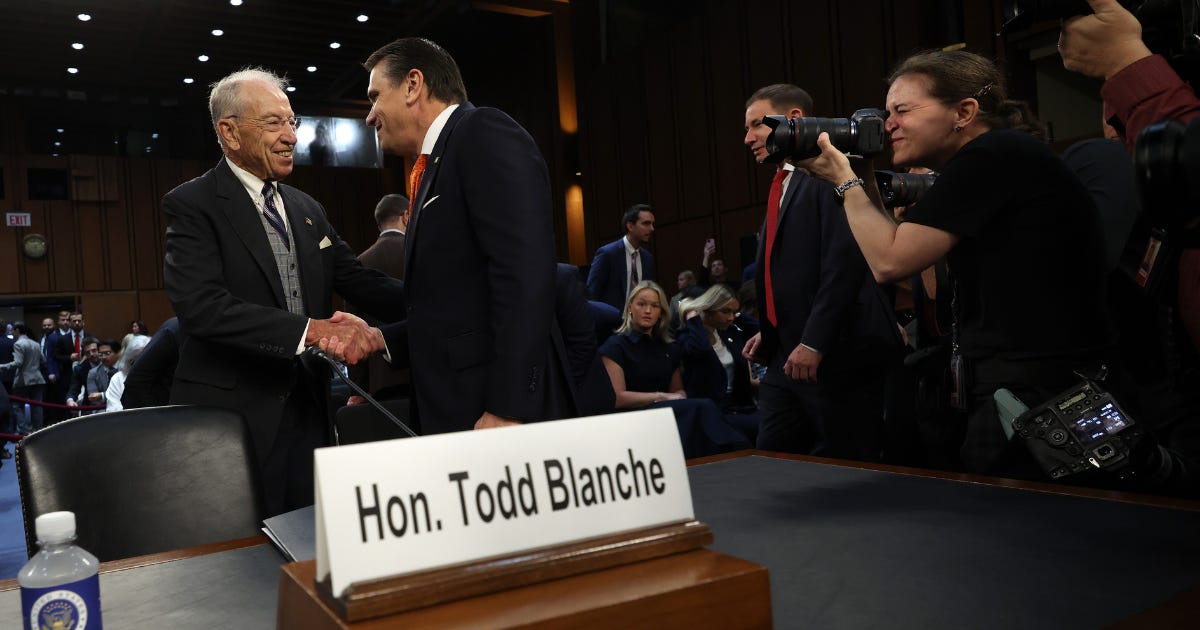
Acting US Attorney General Todd Blanche met with victims of Jeffrey Epstein on Thursday afternoon after two senators told him he was required to do so in order to keep his nomination on track.
The meeting ended a yearlong stalemate between the DOJ and survivors, who say the Trump administration refused to speak with them about Epstein’s criminal network. But the change in course was not due to a change of heart; Blanche was told during his confirmation hearing before the Senate Judiciary Committee that his nomination for attorney general would not advance if he continued to evade Epstein’s victims.
“I can’t understand how this attorney general could find 48 hours to visit with Ghislaine Maxwell, who has been prosecuted for sex trafficking, and can’t find 30 minutes to meet with the survivors,” ranking committee member Dick Durbin (D-Il) told survivor Dani Bensky during the hearing. “I don’t think his name should be called on the floor of the United States Senate until he meets with you. It’s not too much to ask.”
Durbin’s demand later received bipartisan backing from Sen. Thom Tillis (R-NC), who told Blanche he would need to meet with survivors in order to earn his support. With his job on the line, Blanche conceded and spent an hour at the Justice Department headquarters with a handful of women whose personal information had not been redacted from the DOJ’s initial publication of its Epstein Library, which contains a partial release of the government’s case files on Epstein.
But those in attendance described the meeting as more akin to checking a box than a meaningful conversation. Blanche gave noncommittal responses when offered leads on potential Epstein clients and accomplices of, offered unsatisfactory answers about transferring one of their abusers, Ghislaine Maxwell, to a minimum-security prison, and provided no additional details regarding the redactions in the Epstein Files that left survivors exposed, while seemingly protecting those implicated in crimes.
“I don’t think that we had high expectations going into this meeting. I certainly did not. But I didn’t expect to walk out of the meeting feeling the way that we feel right now. It was demoralizing, to say the very least,” Liz Stein, a survivor in attendance, told MSNOW. “It felt like more political posturing and using survivors the way that we’ve been used as political pawns.”
Blanche told reporters he did not intend for the meeting to be anything more than a listening session and encouraged survivors to share any information they have with federal investigators. The hands-off approach failed to win survivors’ support. After the meeting, they urged senators to reject his nomination.
Despite that reaction, Tillis signaled his support and commended Blanche for meeting with survivors, praising him for “doing what all his predecessors over the last two decades never did: meet with the victims of Jeffery [sic] Epstein’s horrific crimes.”

The encounter capped a tense, two-day confirmation hearing in which Blanche’s handling of the Epstein investigation was a focal point for senators. Blanche offered little, repeating his defense that redaction errors were a result of the “Herculean task” of complying with the Epstein Files Transparency Act, which his department has so far failed to do. He also defended the FBI’s conclusion that there was insufficient evidence to investigate anyone else involved in Epstein’s criminal network, despite documents that appear to identify co-conspirators and seized messages to Epstein that seem to incriminate the senders, whose names remain redacted and hidden from public view.
Internal communications between federal agents have also revealed that the DOJ’s decision to close the case was based on a rushed review of less than 7% of the 6 million documents contained within the Epstein Files, and agents did not take financial documents, personal communications, or the majority of witness testimony into consideration when closing the case.
Blanche has been described by many in Congress — and by Bondi, his former boss at the DOJ — as wholly responsible for the Trump administration’s handling of the Epstein investigation. Decisions to close the investigation, grant leniency to the only person convicted, and withhold information that the law requires to be made public have made Blanche the center figure in what is being described as the largest government cover-up in recent history.
“He’s at the center of the cover-up of the Epstein Files,” said Rep. Yassamin Ansari (D-AZ). “When we spoke to Pam Bondi, in her transcribed interview, she mentioned Todd Blanche over 30 times, saying that the Epstein Files cover-up was entirely under his purview.”

COURIER’s newly-launched Epstein investigation project
For too long, the Epstein Class has dealt in wealth, power, and politics to avoid accountability and deny victims & survivors their due justice. The public deserves the truth, but the Trump Administration is failing its legal obligation to deliver it.
That’s why we’re expanding our coverage to follow the money and investigate the power players in and outside the government. With a new database by Thorian AI, we have unprecedented access and ability to navigate more than 1.2M files and we’re sharing access—and what we’re finding—with you.
Subscribe to The Cover-Up and get one concise, easy-to-read email a week that cuts through the noise with the headlines you need and the breakdowns you want.
By staying plugged in and leveraging our reporting to make your own calls-to-action louder, together, we can turn information into justice.
Todd Blanche is a white-collar criminal he committed a felony crime — witness tampering with Ghislaine Maxwell jail transfer in exchange for false testimony.
Todd Blanche exposed Epstein survivors names, deliberately that was no accident that was a felony crime of witness intimidation
Todd Blanche, committing felony obstruction of justice, concealing Epstein files or tampering or spoliation or “sending through the wood chipper” incriminating evidence
Todd Blanche is helping solicit bribes to the criminal trump family from billionaire paedophiles, eager to buy or bribe their way out of the Epstein files
Todd Blanche has helped Donald Trump use the Epstein files transparency act to cynically and disgustingly convert the Jeffrey Epstein blackmail scheme into the Donald J Trump bribery scheme
Todd Blanche is directly covering up child rape, child sex trafficking and paedophile conspiracy by protecting Donald Trump and concealing evidence that proves Donald Trump raped little 13-year-old girls trafficked by Jeffrey Epstein.