



Cam here 👋 bringing you your daily dose of what people are doing – good, bad, and otherwise – in the world of politics. We’re diving into the stories you won’t see anywhere else. And remember, you can also keep up with me over on TikTok and Bluesky.

Since day one of Trump’s political career, people have desperately attempted to normalize his absurd abuses of power and blatant corruption – and 10 years later, much of corporate media remains a victim of their own attempts to return to a sense of normalcy.
It’s time to stop sane-washing the insanity.
What Happened
The Trump administration on Thursday ignored a federal court order to restore White House access to three banned news outlets, instead relying on what it sees as precedent from two other press freedom lawsuits currently stalled in the courts.
The most recent ban came directly from President Donald Trump, who revoked access from Politico, CNN, and MS NOW after criticizing their coverage of him. The outlets sued, arguing that the ban was a violation of the First Amendment.
“MS NOW journalists were denied access to the White House grounds,” MS NOW said in a statement. “MS NOW intends to take any and all steps necessary to defend our First Amendment rights and the essential role of independent journalism in our democracy.”
In defense of the ban, Department of Justice lawyers pointed to two other media restrictions imposed by the administration that have received partial backing from the courts.
One involves the Associated Press, who was banned from the White House press pool over its refusal to go along with Trump’s attempt to rename the Gulf of Mexico. The AP sued the administration in February 2025, access was reinstated in April, but the ruling was paused last fall by the US District Court of Appeals, where the case has sat ever since. AP reporters are still barred from the Oval Office and Air Force One, and have described its access to the White House overall as sporadic. it’s unclear when the lawsuit will continue.
The other ongoing case the DOJ cited involves restrictions put on journalists covering the Pentagon. In October 2025, Secretary of Defense Pete Hegseth told reporters that they would need to sign a pledge allowing the government to dictate their coverage, or their press passes would be taken away. News outlets sued and the matter has been slowly working its way through the courts.
The White House has used the sluggish nature of the court process to its advantage, and appears to be testing what it can get away with in the absence of a vigilant judiciary. Despite preliminary injunctions in both prior cases siding with the news outlets, the Trump administration has continued to further restrict press access while the litigation proceeds.
“Trump’s ban harms both the press and the public, which relies on journalists to report independently on the president and his administration,” said Jameel Jaffer, executive director of the Knight First Amendment Institute at Columbia University. “We hope that Judge Kelly will soon make his temporary order permanent, and that his permanent order addresses the news organizations’ First Amendment claims, not just their Fifth Amendment ones. The First Amendment bars the president from transforming the press corps into a propaganda machine.”
Viewed in the broader context of Trump’s aggression towards the press during his second term, the decision to ignore US District Judge Timothy Kelly’s order restoring access to Politico, CNN, and MS NOW is part of a methodical effort to control information about the administration. In addition to outright bans, the White House has taken control of the press pool away from an independent agency, defunded public media like PBS and NPR, replaced reporting at the state-run Voice of America with far-right misinformation, initiated a retaliatory review of ABC’s broadcast license, ended protections for journalists’ confidential sources, and seized computers from the home of a reporter whose coverage had been critical of the administration.
Attempts to Sanewash
Judge orders White House to ‘immediately’ restore CNN, Politico and MS NOW’s access. Trump shrugs
Media outlets request hearing after journalists’ White House ban despite court order
White House press ban set to continue for now after hearing ends without ruling
Far-Right Spin

Legislation introduced to stop ICE detention warehouses once and for all
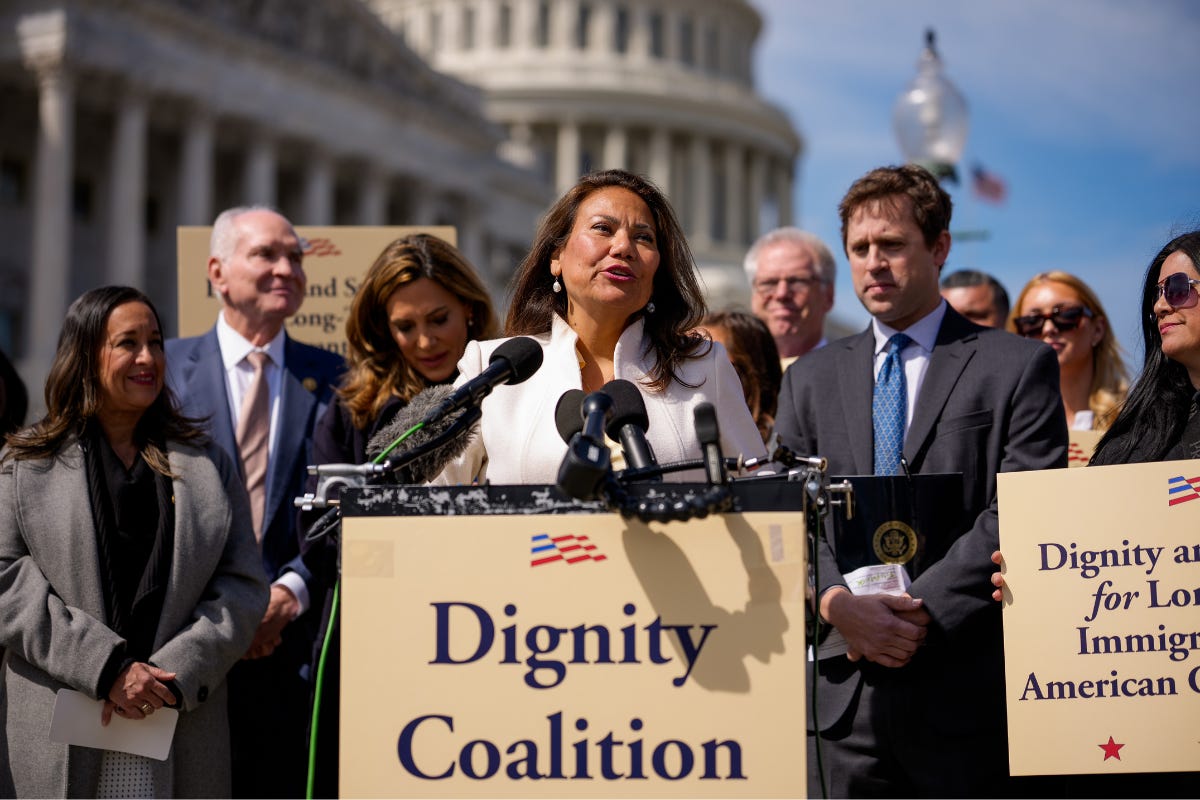
The Trump administration’s failed plan to create mass detention camps shocked and horrified the public, and it could be revived because the loopholes that let the government buy warehouses without local input are still on the books.
Last December, communities across the country were stunned to discover that the Department of Homeland Security had begun purchasing industrial warehouses to convert into detention camps for people arrested by ICE. The news blindsided state lawmakers and city councils, who immediately raised concerns regarding sewage, water, public safety, and potential human rights violations.
The plan was eventually abandoned due to intense opposition from the public, but the legal loopholes that allowed the federal government to spend $1 billion on 11 warehouses — without approval from local authorities and without even complying with standard land survey or permitting processes — still exist. They could be utilized in the future, in a more subtle manner that would not provoke the same public rage.
US Rep. Veronica Escobar (D-TX) worked for months to stop a detention center from opening in her district. DHS bought an industrial complex in Socorro, Texas, for $122 million but refused to engage with the town council or solicit public input — an offense Escobar plans to make illegal. In September, she introduced the DHS Community Consultation Act, which would require DHS to adhere to a 60-day public comment period, actively engage with community members and leaders, and honor any local ordinances that prohibit detention facilities in the region.
“The administration cannot do whatever it wants, but there are gaping loopholes that we need to make sure that we close,” Rep. Escobar told COURIER. “We need to put up guardrails around this and future administrations so that we protect the rights of communities.”
Escobar’s legislation would also require DHS to assess the impact any facility would have on public utilities — like water infrastructure, electric power grids, and roads — healthcare and emergency services, and overall community health. It would establish contagious disease protocols that align with local mandates, reducing the risk of an outbreak at the facilities.
Ultimately, the legislation would codify local control that many elected officials thought was already the law of the land. It turned out those protections were merely societal norms that were quickly bulldozed by the Trump administration. Communities have seen the same playbook with data centers, where permitting requirements and tax burdens have often been waived without regard for public concerns.
“The American people are really angry about a number of issues, and a number of ways that the administration has exploited these loopholes,” said Escobar. “When you look at data centers that are proliferating across the country, including in my community, frequently without community consultation, frequently with a complete disregard for natural resources and air quality — the same thing goes for immigration detention, or for border wall construction. Congress really needs to take back much of the authority that has been given to the executive over decades. We have to shut down all of those loopholes and opportunities that are used by rogue administrations to exert their will over the will of communities.”
As it stands, the DHS Community Consultation Act faces an uphill battle until next year: the House is in recess until November, and Speaker Mike Johnson is unlikely to allow a vote on any legislation that doesn’t have Trump’s express support. Escobar is hopeful that if Democrats take control of Congress, her legislation will quickly be brought to the floor for a vote.

Zorro Ranch investigation sparks action to close ‘Epstein Loophole’
By Jackie Appel, investigative reporter

A technicality in New Mexico’s legal code allowed one of the most notorious sex traffickers in modern history to operate inconspicuously in the state for decades. This year, lawmakers are taking steps to close that loophole.
On June 30, 2008, Jeffrey Epstein plead guilty to soliciting prostitution and procuring a minor for prostitution in the state of Florida. Considering what is now known about Epstein’s vast trafficking empire, the charges seem ludicrously small, especially considering the fact that the jail time to which he was sentenced was served in large part from the comfort of his own home and an office he controlled.
However, the sentencing did accomplish one very important thing: it forced Epstein to register as a sex offender.
Typically, this would be a significant step towards keeping people safe from a man like Epstein. Sex offenders are often barred from living in or working near certain places, and they need to let state governments know they are in the vicinity any time they set up residence across state lines.
Except, as it turns out, that wasn’t true in New Mexico, where Epstein owned and maintained his massive Zorro Ranch property from 1993 until 2019. Following his 2008 conviction, Peter Schoenburg—one of Epstein’s lawyers—noticed a loophole in New Mexico’s laws that meant he would not need to register as a sex offender in the state, even though his conviction required him to register in Florida and New York, where he also owned property.
That loophole remains open to this day. Now, legislators are trying to close it.
Slipping through the cracks
As the Santa Fe New Mexican reported earlier this month, State Rep. Meredith Dixon (D-Albuquerque) said she intends to introduce “a comprehensive package for victims and survivors” during the next legislative session in 2027. She is working closely with Attorney General Raúl Torrez, who she credits with “spearheading this effort.”
Most central to the Epstein case, the package would increase the protected age listed for victims of sexual crimes from 16 to 18. In doing so, legislators would finally close the loophole Epstein used to avoid registering as a sex offender in the state.
While the actual age of Epstein’s victim in his 2008 conviction is disputed, court documents list her as 17 at the time when she was sexually abused by Epstein — and that distinction played a major role in how Epstein got around the court order to register as a sex offender in every state he maintained residence.
In Florida, where Epstein was convicted, the law required him to register as a sex offender for “procuring [a] person under [the] age of 18 for prostitution.” In New Mexico, the closest similar statute is called “sexual exploitation of children by prostitution.” While this sounds like it might be even more all-encompassing than the Florida law, the text specifies that in order for the statute to apply, the victim must be “a child under the age of sixteen.” In Epstein’s case, that meant that the charge of soliciting prostitution from a minor could not legally have been levied against Epstein in the state of New Mexico because his victim was 17, and thus, the state’s registration requirements did not apply.
It was this technicality Epstein’s attorneys leaned on, and ultimately, they convinced state officials that Epstein did not have to register as a sex offender. The decision kept him off local law enforcement’s radar as he built his trafficking empire, where he used his wealth and influence to oversee the abuse of over 1,000 victims — at least 30 of which were assaulted at Zorro Ranch.
Building a safer future
While closing the loophole does little to those who have already been harmed, lawmakers believe correcting the law would do a world of good to protect potential future victims from suffering the same fate as those who were abused by Epstein.
The package compiled by Dixon and Torrez has several objectives beyond simply closing the ‘Epstein loophole,’ many of which fall under the umbrella of aligning New Mexico more closely with federal Sex Offender Registration and Notification Act (SORNA) standards by adding and updating crucial definitions to relevant statutes.
“The [original] reason that I was interested in making the updates to SORNA was actually from a budgetary perspective, because the fact that New Mexico is out of compliance with the federal standards means we are not able to access certain grant monies that we could use to support victims” Dixon told COURIER. “We have not kept up with the changing times. So a lot of our definitions and registry requirements are either outdated or they’re too lax compared to other states. Our effort is to bring our standards up to get us closer to compliance with what the federal standards want.”
Unlike most reporting around Epstein — which is often scandalous and attention-grabbing — the legislative package will be decidedly dull, as it will deal mainly with tweaks to the language and definitions in existing statues. But these small changes (which should be released to the public sometime in October) could mean a world of difference for victims trying to get justice.For example, Dixon said the package will attempt to change the language of the statute outlining who must register as a sex offender.
“I think [one of] the most important [changes] that we are trying to [make] is add sex trafficking. So, if you are convicted of sex trafficking, that would be an offense for which you would need to register as a sex offender,” Dixon explained.
“Right now, it is not a definition that is encompassed in our statute, so that is something that we need to add,” she continued. “There’s exploitation, solicitation, incest, enticement. And there’s sexual exploitation of children by prostitution, but not [sex trafficking].”
The package Dixon and Torrez have compiled heavily focuses on adjusting statutes that could allow perpetrators to operate in the state of New Mexico in much the same way that Epstein did. But Dixon and Torrez intend for it to have broader implications that protect even more potential victims.
“One of the bills that is going to be included is allowing victims — especially child victims — to refuse a pre-trial interview,” Dixon told COURIER. As of right now, victims of trafficking cannot bow out of pre-trial interviews, potentially subjecting them to extended and numerous sessions of answering questions that have the potential to bring their traumas back to the forefront of their minds. “If the defense counsel wants to interview a child victim five times, they’re allowed to do that, and all of that’s before trial.”
Another piece of legislation is focused on removing barriers for victims coming forward to report instances of human trafficking, namely, removing the 10-year statute of limitations. “I think we know now that victims frequently are not ready to speak immediately,” Dixon said, “and so we need to allow them additional time.”
As for why officials seem to have chosen now as the time to finally address many of these concerns, Dixon (perhaps macabrely) credits the recent increased visibility of the Epstein case.
“I have run legislation and worked with colleagues to amend SORNA in the past, and it hasn’t made it to the House floor,” she said. “Now, with everything that’s going on with the Epstein Commission looking at Zorro Ranch and this loophole, I think there’s a better understanding — by legislators and members of the public — of exactly why we need to make some of the changes that we’ve been asking for.”
“I’m very optimistic,” she said, regarding the chances of the package passing during the next legislative session, which will take place at the beginning of 2027.
Hopefully, for the sake of potential future victims, she’s right.
COMING UP: Next week, we’ll have stories on a new criminal investigation into the executors of Jeffrey Epstein’s estate, Richard Kahn and Darren Indyke. Got questions? Drop ‘em in the comments!
Support our journalism at COURIER
Democracy dies behind a paywall, which is why our journalism is — and always will be — free.
But to keep our commitment to the free access to information, we need support from those who have the means, believe in our mission, and support our unique model.