


Cam here 👋 bringing you your daily dose of what people are doing – good, bad, and otherwise – in the world of politics. We’re diving into the stories you won’t see anywhere else. And remember, you can also keep up with me over on TikTok and Bluesky.
Since day one of Trump’s political career, people have desperately attempted to normalize his absurd abuses of power and blatant corruption – and 10 years later, much of corporate media remains a victim of their own attempts to return to a sense of normalcy.
It’s time to stop sane-washing the insanity.
What Happened
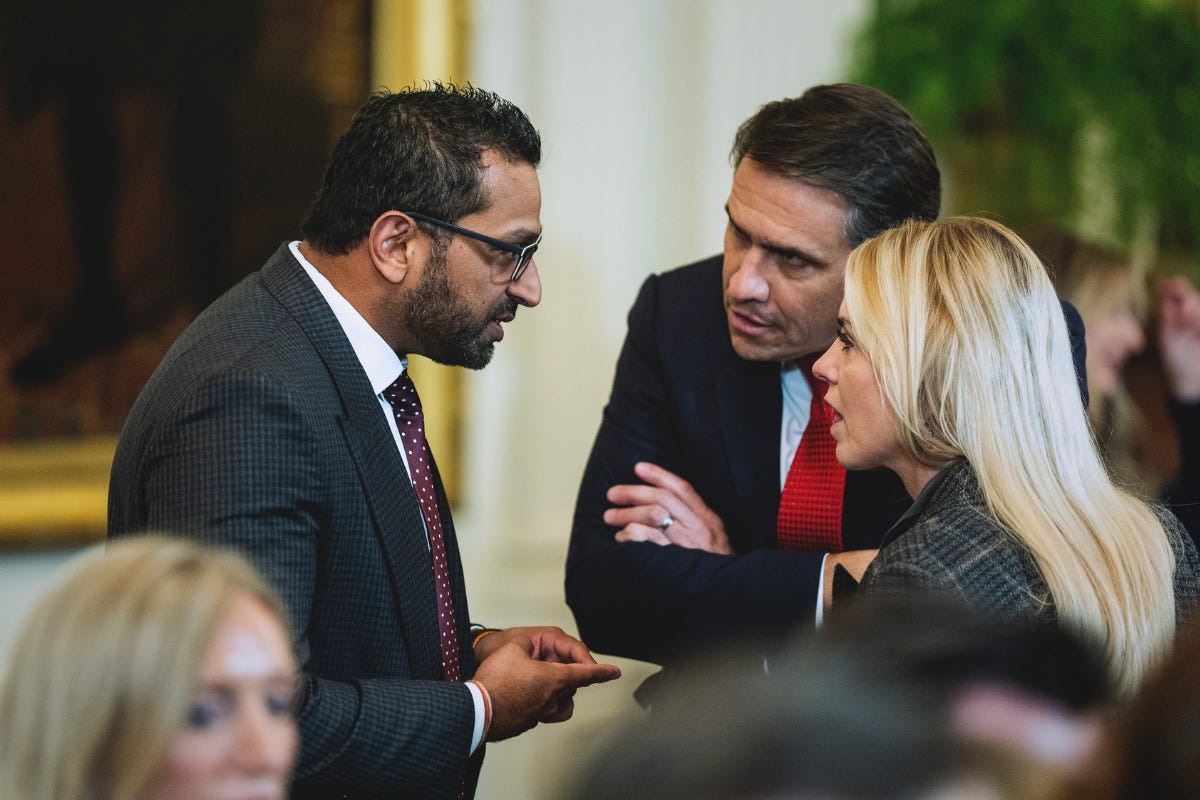
What initially appeared to be a failed political stunt by the Trump administration — gifting far-right influencers binders of material related to Jeffrey Epstein — now appears to have served another purpose entirely: providing cover for a massive redaction effort designed to protect the president.
Internal correspondence between federal agents, published as part of the Epstein Files Transparency Act, outlines exactly how former US Attorney General Pam Bondi used the public stunt to quietly launch the redaction project within the DOJ. In a public letter sent to FBI Director Kash Patel on Feb. 27, Bondi demanded that his bureau “deliver the full and complete Epstein Files to my office” in Washington, DC.
“By 8:00 a.m. tomorrow, February 28, the FBI will deliver the full and complete Epstein files to my office, including all records, documents, audio and video recordings, and materials related to Jeffrey Epstein and his clients, regardless of how such information was obtained,” Bondi wrote. “The Department of Justice will ensure that any public disclosure of these files will be done in a manner to protect the privacy of victims and in accordance with law, as I have done my entire career as a prosecutor.”
Patel went to great lengths to help prop up the facade of transparency, loading physical documents into a rented U-Haul so the full files could be transferred simultaneously. The operation, first reported on by ABC News in March 2025, was at the time characterized as a Trump-style media stunt, a cartoonish waste of time and resources meant to satisfy his supporters’ lust for the release of the Epstein Files.
But internal DOJ communications tell a different story. Officials made clear that the case file consolidation was intended to facilitate a massive redaction project that ultimately cost nearly $1 million in overtime pay alone. The process focused on redacting names of high-profile individuals like Donald Trump, while exposing the names and violating the privacy of hundreds of Epstein’s victims.
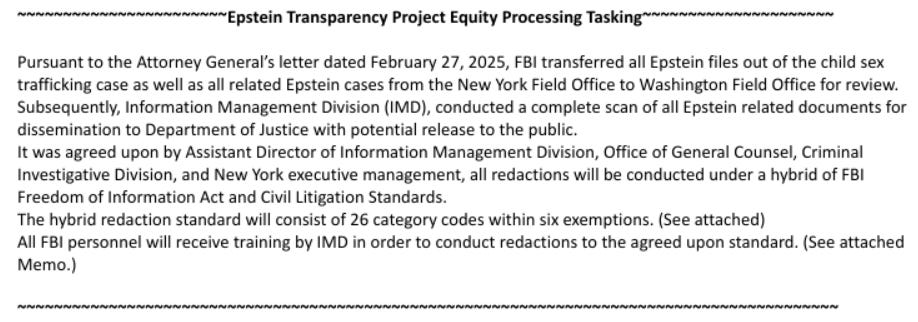
“Pursuant to the Attorney General’s letter dated February 27, 2025, FBI transferred all Epstein files out of the child sex trafficking case as well as all related Epstein cases from the New York Field Office to Washington Field Office for review,” the memo stated. “All redactions will be conducted under a hybrid of FBI Freedom of Information Act and Civil Litigation Standards.”
The Files eventually made their way to a field office in Winchester, Virginia, not Washington, where the agents assigned to the project were poorly trained on the hybrid redaction process. According to a whistleblower who contacted Sen. Dick Durbin (D-IL) last year, agents instead prioritized cataloging every mention of Trump and removing his footprint from the files.
“My office was told that these personnel were instructed to ‘flag’ any records in which President Trump was mentioned,” said Durbin. “Despite tens of thousands of personnel hours reviewing and re-reviewing these Epstein-related records over the course of two weeks in March, it took DOJ more than three additional months to officially find there is ‘no incriminating client list.’”
The determination that there is no client list — and not enough evidence to prosecute any of Epstein’s clients, accomplices, or co-conspirators — stems from Bondi’s rush-order redaction assignment. Emails contained within the Epstein Files detail how Patel would occasionally make requests for information, which would later be carefully used to nip any investigative threads in the bud.
When the redaction process first began, Patel asked agents on duty to determine whether there was any photo or video evidence that could be used for future prosecutions. Weeks later, an agent sent Patel a detailed and nuanced response in the negative.
“All videos and images from the case file and from Epstein’s residences and devices were reviewed for evidence of a crime,” the agent wrote. “Those reviews revealed no evidence from any of the searches we conducted or any of the files we reviewed that any videos or other images exist of any victims in this case being sexually abused. Nor did those reviews reveal any evidence that anyone other than Epstein and Maxwell participated in the sexual abuse of victims in this case.”
This specific finding — that there was no visual evidence that could incriminate anyone other than Epstein — was later cited more broadly in Bondi’s decision to close the case without pursuing further prosecutions, omitting the possibility that evidence could still exist in financial records, private emails, or other text-based documents in the Files.
The decision marked the end of an anti-climactic, whiplash-inducing chapter in Bondi’s saga with the Epstein Files. For a comprehensive breakdown of Bondi’s time at the DOJ — and how it became inexorably tied to an apparent cover-up for the Trump administration — American Freakshow has put together a timeline of the former attorney general’s “swan song.”
Bondi is expected to appear before the House Oversight Committee on Friday, where congressional investigators plan to question her about her stewardship of the Epstein Files during her brief tenure as Attorney General. Republicans on the committee have agreed to keep the interview off-camera and not under oath, a compromise Democrats say is unacceptable. Rep. Yassamin Ansari (D-AZ), who sits on the committee, said Bondi has much to answer for, and relegating the deposition to a transcribed interview as opposed to a recorded video is a disservice to the American public.
“We need to make sure that the [Republican] majority demands that Pam Bondi testify under oath and on video. We’ve been calling for this, but we have not received reassurances,” said Ansari. “It’s up to her whether or not she’s going to be honest. She’s been at the center of this. She has a lot of knowledge. She has an opportunity here to really course-correct and, at least, save herself in this cover-up.”

Trump border wall destroys 1,000-year-old sacred site in Arizona
Written by Zineb Haddaji, The Copper Courier / COURIER
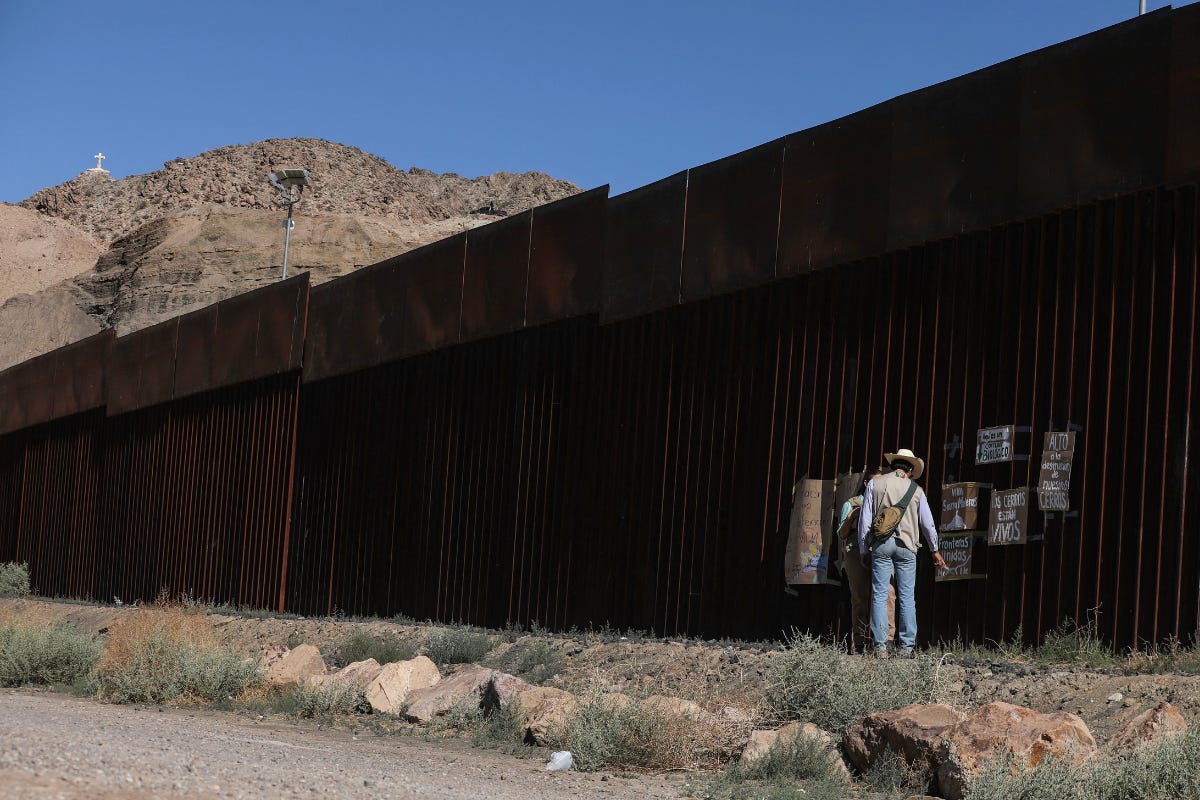
The Tohono O’odham Nation said April 28 it was notified that a Department of Homeland Security (DHS) contractor building a secondary federal border wall destroyed the Las Playas Intaglio — A 1,000-year-old, fish-shaped geoglyph etched into the floor of the Cabeza Prieta National Wildlife Refuge, on the ancestral lands of the Tohono O’odham Nation. About 60 to 70 feet of the roughly 200-foot-long geoglyph were lost. The site had been flagged by a cultural protection monitor as one for contractors to avoid.
For the Nation, the site is not just land whose status can simply be changed by law. It represents a living connection to their ancestors, their history, and their identity. This wall also threatens the animals the tribe considers “spiritual guardians”, including endangered jaguars whose range spans the border.
The Las Playas Intaglio acted as a spiritual compass pointing toward the ocean, which is tied to the salt-gathering ceremonies that bring the summer monsoon rains to replenish the desert, according to David Martinez professor of American Indian studies at Arizona State University.
“When that Intaglio is damaged, and when it’s destroyed, it’s destroying that kinship relationship that we have to maintain… with the spirits that keep our world running,” Martinez said. “The world is out of balance right now because of that destruction.”
Haddaji’s full story available here.
It’s easy for individual members of Congress to get overlooked by national outlets as they quietly skate to reelection again, and again, and again. The following is an overview of different congressional representatives you may not have heard of, with fun facts about their origin stories they’ve tried to keep out of the public narrative.
US Rep. Ken Calvert, California’s 41st Congressional District
Since taking office in 1993, Rep. Calvert has:
Seen his net worth increase from $3 million to nearly $23 million
Sponsored 284 bills, 12 of which have been signed into law
Received more money from the defense industry during the 2022 midterms than almost any other congressional candidate
Staffed his congressional office with dozens of lobbyists, including representatives for Lockheed Martin, Boeing, and the National Potato Council
Received a $265,000 campaign boost from Elon Musk during the 2024 election
Used his position to allegedly score lucrative land deals for himself and his realtor friends
Promised to only serve six terms, but is now serving his 16th and running for reelection
Fun Facts
Throughout his three decades in Congress, Rep. Calvert has made it a priority to bring his real estate expertise to Washington — particularly when it scores him a nice payoff. He’s shown an acute ability to use earmarks — guarantees in the federal budget that certain amounts of money can only be used for certain projects — to make previously worthless land spike in value. Maps of earmarked transportation projects he’s signed off on are often lined with properties tied to Calvert. Such dealings were found to violate state laws in 2007 and made him the subject of an FBI investigation in 2009. As recently as 2024, Calvert faced renewed criticism after securing millions in federal funds to improve the areas around 10 rental properties he owns in Riverside.
But it hasn’t all been business: during his first term, Calvert was caught in what he described as “an extremely embarrassing situation” with someone police described as a “known prostitute.” The incident occurred during Calvert’s prime mid-life crisis years, shortly after his wife left him. It ultimately resulted in neither criminal nor political consequences.
Advertise in this newsletter
Do you or your company want to support COURIER’s mission and showcase your products or services to an aligned audience of 190,000+ subscribers at the same time? Contact advertising@couriernewsroom.com for more information.
So deeply saddened about the destruction of The Las Playas Intaglio. These awful people are hallow inside.
Good grief. Thank you for sharing this. Bondi will lie. She'll probably mention the stock market & attack the questioners again too. I think she's mentally ill.
I'm surprised that I didn't hear about the Native American monument. Hasn't the government damaged them enough. They have no shame. Especially Trump. He has damaged our relationships from the Northern border to the Southern border!