This newsletter is brought to you by Action Network Boost, a new set of features built for the most advanced digital programs.
Cam here 👋 bringing you your daily dose of what people are doing – good, bad, and otherwise – in the world of politics. We’re diving into the stories you won’t see anywhere else. And remember, you can also keep up with me over on TikTok and Bluesky.
Since day one of Trump’s political career, people have desperately attempted to normalize his absurd abuses of power and blatant corruption – and 10 years later, much of corporate media remains a victim of their own attempts to return to a sense of normalcy.
It’s time to stop sane-washing the insanity.
What Happened
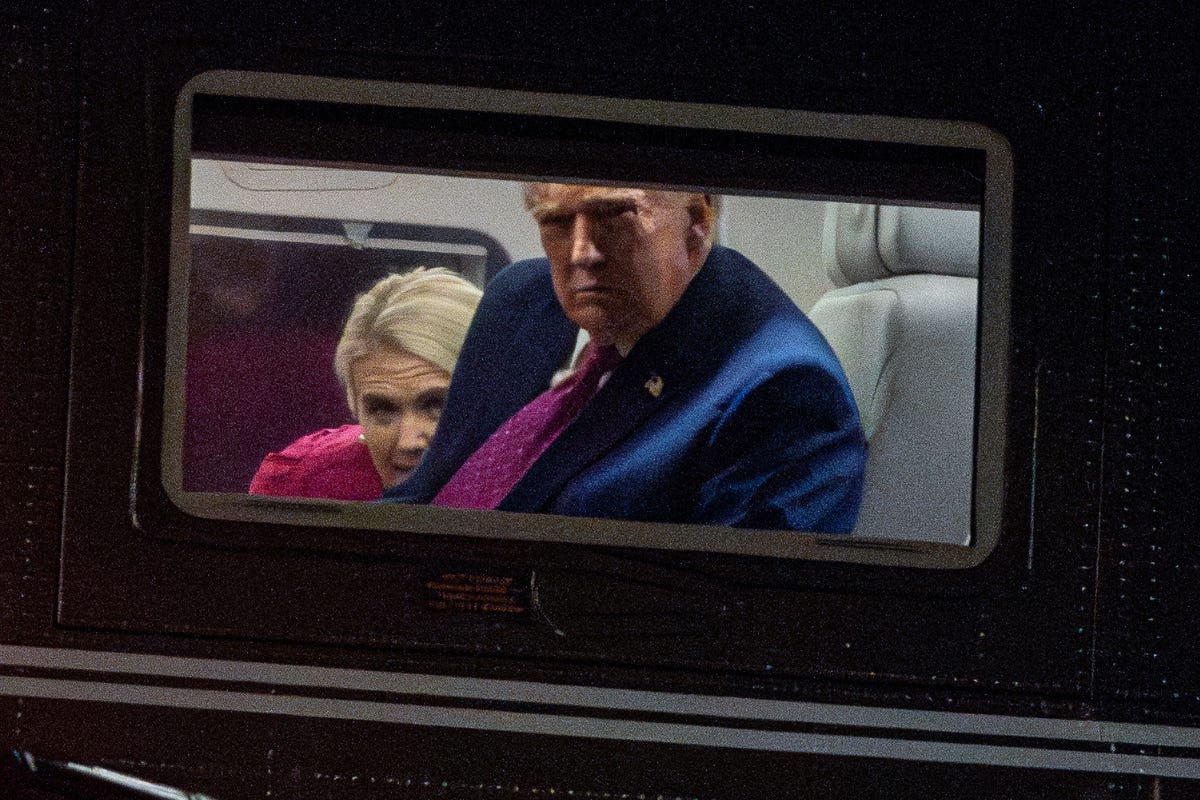
Stories have circulated for years about Donald Trump’s overly attentive aide, Natalie Harp, but a speech by Sen. Jon Ossoff (D-GA) earlier this month thrust her into the national spotlight, eliciting both curiosity and concern for a woman whose entire world seems centrally focused on serving at the pleasure of the president.
“[Trump] doesn’t want to do the job,” said Ossoff. “He wants to build his ballroom and travel with Natalie on their apparently defenseless flying palace gifted by the Emir of Qatar.”
While Harp’s intense dedication has been chronicled piecemeal by the Washington Post and New York Times, the full scale of her loyalty is difficult to grasp without a comprehensive accounting of her ascent. The role of an executive assistant would not normally be a matter of national interest, but Harp’s role as a conduit of information feeding Trump’s ego and obsession with conspiracy theories — coupled with her active presence in private meetings with cabinet members and access to communications involving national security — has garnered intense public scrutiny in the days following Ossoff’s remarks.
To that end, COURIER has compiled a comprehensive timeline of Harp’s rise, from teenage George W. Bush fangirl to one of the most influential people in the Oval Office.
1991: Harp is born and raised in a Christian fundamentalist household, where she is taught to adhere to a belief in American Exceptionalism.
2007: At 16 years old, Harp begins writing President George W. Bush letters of support and admiration.
2012: She graduates from Point Loma Nazarene University, a Bible College in San Diego.
2015: Harp receives her Masters degree from Liberty University, a far-right, Christian fundamentalist school.
2017: Harp is diagnosed with bone cancer and becomes disillusioned with the US healthcare system. She responds positively to treatment and the cancer eventually goes into remission.
2019 – June 12: In a LinkedIn post critical of Joe Biden’s healthcare record, Harp misattributes a law signed by Trump as the reason she was able to access lifesaving cancer medication.
2019 – June 23: Harp is invited to talk about her LinkedIn post on Fox News, where she credits her survival to Trump. Trump sees the segment, and later invites her to join his re-election campaign’s advisory board.
2020: Harp is hired by the far-right media company OANN, where she hosts a show focused on Trump’s presidency and disproven conspiracy theories surrounding the 2020 election.
2020 – July 17: Harp’s father dies by suicide. Her brother, Preston, later said he believes his sister’s infatuation with Trump was born out of the desire for a father figure after their dad’s death.
2020 – August 24: At Trump’s request, Harp speaks at the RNC.
2021: Harp maintains her support for Trump after the Jan. 6 Attack on the Capitol, even as a number of staff, aides, and cabinet members resigned for his role in the insurrection.
2022: Harp quits OANN and moves to Florida, where Trump hires her as an assistant. She accompanies him while golfing and travels with him to his various court proceedings in Georgia and New York.
“She is indicative of the people around him who just love him,” a Trump adviser told the Washington Post at the time. “Love him too much.”
2023: Harp is entrusted with helping manage Trump’s social media accounts. Unlike others who manage his accounts, she appears to post whatever he tells her to without question, including images and text posts that cause political controversy and potentially complicate his court cases. Throughout the year, Harp sends Trump a series of letters that other staff members consider highly concerning.
Excerpts obtained by the New York Times include, “You are all that matters to me,” “I don’t ever want to let you down…Guardian and Protector in this Life,” and “I want to bring you joy… to feel like we can get through a day without ever having to talk ‘work.’”
2023 – March: Harp provides Trump with an edited photo depicting him holding a baseball bat to the head of Manhattan District Attorney Alvin Bragg. Trump posts it the week before Bragg indicts him on 34 felony counts of falsifying business records.
2023 – October: Harp screams at the person managing Trump’s motorcade because there is no seat for her on the morning of his trial. Unwilling to separate herself from the president and arrange alternate transportation, she rides in the trunk of an SUV.
2024: Harp joins Trump’s reelection campaign. She continues traveling with the president and joining him on the golf course, eventually carrying a portable printer with a backup battery pack so she can print out social media posts and news reports favorable to him. Her coworkers on the campaign nickname her “the human printer.”
2024 – January: Harp publishes 40 social media posts about Jean E. Carroll in less than an hour on Trump’s accounts. It’s unclear whether she acts independently or Trump dictates the messages to her. She is subsequently given more control over his social media and communications, including the ability to send text messages on Trump’s behalf.
2024 – August: Harp, posing as Trump and using his phone number, sends a series of aggressive text messages to Republican megadonor Miriam Adelson.
2024 – September: Harp takes a screenshot of a private message Ukrainian President Volodymyr Zelenskyy sent to Trump and posts it on his Truth Social account.
2024 – November: Trump wins reelection and creates the role of special assistant and executive assistant to the president for Harp.
2025: White House Deputy Chief of Staff Dan Scavino, who for years managed Trump’s social media presence, passes the majority of that responsibility to Harp, who relies on a large repertoire of AI-generated images and videos throughout the year.
2026 – February: Harp posts a racist AI-generated video of former President Barack Obama and former First Lady Michelle Obama. The post is later deleted.
2026 – April: Harp posts an AI-generated image depicting Trump as Jesus Christ. The post is later deleted, and Trump takes credit for posting it.
2026 – July: The Trump administration discovers a credible plan to attack Air Force One while the president is in Turkey. Trump and Harp are hidden in a catering container and secretly boarded onto a separate plane for safety. Journalists, cabinet members, and other White House staff traveling with Trump are not told of the potential attack and are made to board Air Force One.
Supercharge your program with Action Network Boost
Powerful features for the most advanced digital programs, including deliverability reporting, priority support, a new way to dig deeper into your data, simplified email customization, and much, much more. Sign up and get 10% off Boost here >

Only one warehouse remains from Trump admin’s mass detention camp plan
An eight-month effort to stop the Trump administration’s plan to turn industrial warehouses into mass detention camps has proven massively successful, with all but one of the 23 selected locations abandoned or paused indefinitely.
Rep. Veronica Escobar (D-TX) announced the most recent closure on August 11: a planned detention center just outside Socorro, Texas, that would have been the largest in the country. The 1 million-square-foot industrial park, made up of three warehouses, was purchased by the Department of Homeland Security for $123 million in February. The plan sounded straight out of a dystopian science fiction novel: remodel the buildings into an Amazon-style distribution center — “Prime, but with human beings,” according to former ICE Director Todd Lyons.
“I am really proud of the way the community came together. Early on, the city of Socorro voted to create a moratorium on this and other projects,” said Escobar. “This was a priority for me and my team. We did a lot of work, elevating the voices of the community, ensuring that the decision makers at the highest levels of the federal government understood the significant challenges that having a detention facility at Socorro would create, and we spent a lot of time working various processes to get to this end result.”
The Socorro complex was one of 11 warehouse sites the Trump administration purchased for a combined $1 billion, with the express purpose of holding people detained by ICE indefinitely. Eleven other locations were in the early stages of development, but swift, visceral opposition from local residents killed those projects before sites could be purchased. Only one facility is still in the works: a 64,000-square-foot industrial warehouse in San Antonio, Texas, that officials expect to open in Spring 2027. Two other purchased sites, one in Arizona and another in Maryland, are paused indefinitely due to lawsuits brought by the states’ attorneys general.
A searchable map of all 23 locations, including their current status, can be found here.

The fire sale of seven warehouses, along with the uncertain future of the few sites still in DHS’ possession, marks the end of an era of aggressively rapid anti-immigration expansion spearheaded by Trump advisor Stephen Miller. In Trump’s first year back in office, Miller sought to deport one million people, strip citizenship from millions more, and develop a national mass incarceration network to hold whoever stood in his way. Public opinion on the administration’s handling of immigration quickly soured as Miller’s efforts resulted in the illegal detention and deportation of citizens and noncitizens alike, inhumane conditions at detention centers, and warzone-style military operations in US cities politically opposed to the president.
The breaking point came in January 2026, when ICE agents participating in Operation Metro Surge killed two US citizens, Renée Nicole Good and Alex Pretti. Protests erupted nationwide, fueled further by news that the Trump administration planned to accelerate its efforts with its warehouse detention plans. Once the locations of the warehouses became public, they became rallying points for activists, who effectively pressured local leaders and warehouse owners to block DHS from turning the sites into detention camps.
Within a month, DHS Secretary Kristi Noem was fired, and her replacement, Markwayne Mullin, announced that the warehouse plan was on hold. The project has since been slowly dismantled, and activists are now working to ensure the remaining DHS-owned sites in Arizona, Maryland, and Texas meet the same fate as the complex in Socorro.
“DHS didn’t do this because they wanted to,” said Brent Peak, Co-Chair of Arizona’s Northwest Valley Indivisible. “This is a real win. It is not the end of the fight though, and we’re not walking away until this prison camp is shut down for good.”
Support our journalism at COURIER
Democracy dies behind a paywall, which is why our journalism is — and always will be — free.
But to keep our commitment to the free access to information, we need support from those who have the means, believe in our mission, and support our unique model.
Supercharge your program with Action Network Boost
Powerful features for the most advanced digital programs, including deliverability reporting, priority support, a new way to dig deeper into your data, simplified email customization, and much, much more. Sign up and get 10% off Boost here >