


Cam here 👋 bringing you your daily dose of what people are doing – good, bad, and otherwise – in the world of politics. We’re diving into the stories you won’t see anywhere else. And remember, you can also keep up with me over on TikTok and Bluesky.
Highly sensitive financial documents left mistakenly unredacted by the US Department of Justice appear to directly contradict what Jeffrey Epstein’s personal attorney told congressional investigators last month.
Darren Indyke, Epstein’s attorney and one of his closest business associates, told the US House Oversight Committee in March that he did not withdraw hundreds of thousands of dollars from Epstein’s Deutsche Bank business accounts in a way to avoid reporting regulations designed to alert authorities of potential money laundering or human trafficking.
However, new information found in Suspicious Activity Reports (SARs) submitted by Deutsche Bank to the US Treasury’s Financial Crimes Enforcement Network reveals that Indyke repeatedly inquired about avoiding Currency Transaction Reports (CTRs), and explicitly told bank employees he would stagger his withdrawals to bypass them.
From 2003 until 2019, thousands of cash withdrawals totaling millions of dollars from Epstein’s accounts prompted bank employees to file numerous SARs on Epstein and the employees who ran his multi-billion dollar empire: Indyke, Richard Kahn, and Harry Beller. These reports, combined with internal Deutsche Bank correspondence, expose Indyke’s clumsy attempts to evade reporting regulations by spacing his massive cash withdrawals out over the course of several days —a tactic he categorically denied during his deposition with the US House Oversight Committee.
“My primary role was to provide corporate, transactional and general legal services to Mr. Epstein and his companies,” Indyke stated. “As part of its standard policy, the bank itself imposed a $7,500 limit on daily cash withdrawals. I was not attempting to structure such withdrawals to avoid federal reporting requirements. Quite the contrary. I simply sought to comply with the bank’s internal requirements and limits with the bank’s full knowledge.”
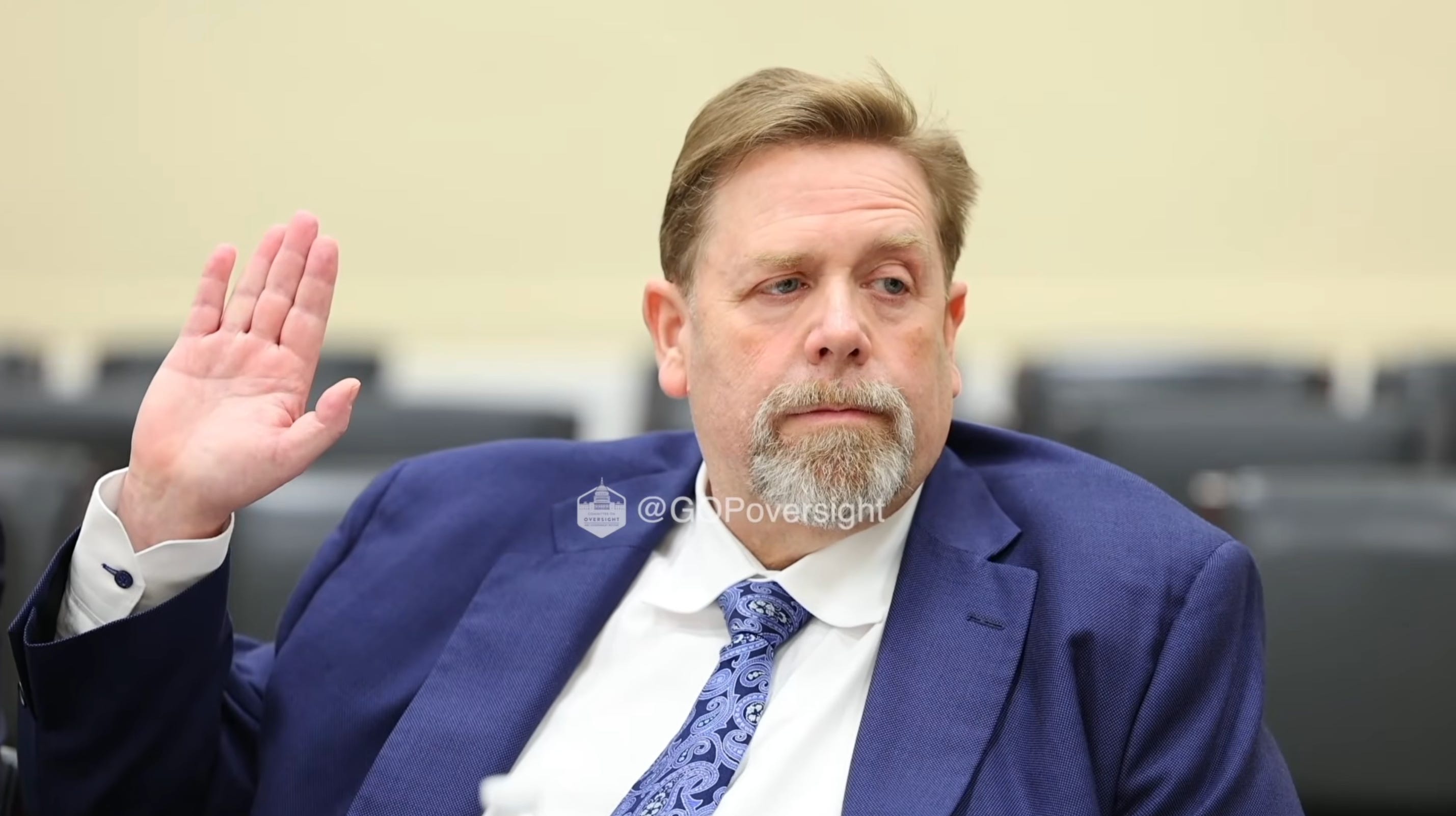
Indyke’s misdirection before the Oversight Committee was delivered shortly before President Donald Trump fired US Attorney General Pam Bondi, partially over her failed attempt to cover up Trump’s involvement with Epstein. Bondi is scheduled for a deposition on April 14, and how the committee responds to Indyke’s testimony could influence how seriously Bondi and others who are similarly subpoenaed to testify take Congress’ investigation into Epstein.
“In a functioning system, there should absolutely be consequences for that. For instance, perjury is illegal, right? There’s a reason why one is under oath. There should be legal accountability for when someone does it. In fact, Pam Bondi has also committed perjury,” said Rep. Summer Lee (D-PA), ranking member of the Oversight Committee. “Indyke is that deeply connected, and said that he knows nothing? It’s absurd. When we talk to survivors and their lawyers, they all put us in that direction. These are the people they said, ‘the banks, Indyke, go talk to those people.’”
Indyke worked for Epstein for over 30 years, taking him on as a client in 1986. By the 1990s, Epstein was Indyke’s sole client, and relied on him to establish countless LLCs, facilitate real estate deals, develop a personal tax haven on the US Virgin Islands, and withdraw large sums of cash on his behalf.
Though there is little evidence to suggest the two had a close personal relationship, Indyke repeatedly described Epstein as a generous, caring individual. He told congressional investigators Epstein offered to pay for Indyke and his wife’s fertility treatments, and admitted to having received millions in compensation over the years. Epstein also left Indyke $50 million in his will.
During this time, Epstein was convicted for soliciting prostitution from a minor in Florida, and has been accused by over a thousand women of sexual abuse and human trafficking. While Epstein built a network of wealthy, powerful clients for his multi-billion dollar sex trafficking operation, Indyke handled the business side. At the time of his death Epstein’s estate was worth nearly $600 million. Indyke and Kahn are now the co-executors of Epstein’s estate, and have much to gain from protecting it from criminal prosecution.
Rep. Yassamin Ansari (D-AZ), a member of the Oversight Committee who questioned Indyke during his deposition, believes Indyke was disingenuous throughout, repeatedly attempting to distance himself from his former boss.
“If he was testifying under penalty of perjury, and caught lying, that’s extremely serious,” said Ansari. “I did not feel that he was being honest. And it is mostly based on the fact that I felt his demeanor and his responses were an attempt to significantly downplay his relationship with Epstein, despite the facts. We know they had a decades-long professional relationship, and Jeffrey Epstein paid him tens of million dollars.”
The discovery of the unredacted documents comes as part of The Cover-Up, COURIER’s ongoing investigation into Epstein’s sex-trafficking operation and the federal government’s efforts to shield his clients and co-conspirators from accountability. While the SAR reports currently available in the Department of Justice’s Epstein Library are fully redacted, the original Jan. 30, 2026 publication of the documents left its contents visible to the public. The originals were found using COURIER’s new public database of the Epstein Files — created by tech startup Thorian AI — that has stored every version of every document the DOJ has released on Epstein, despite the Trump administration’s attempts to keep them from public view.
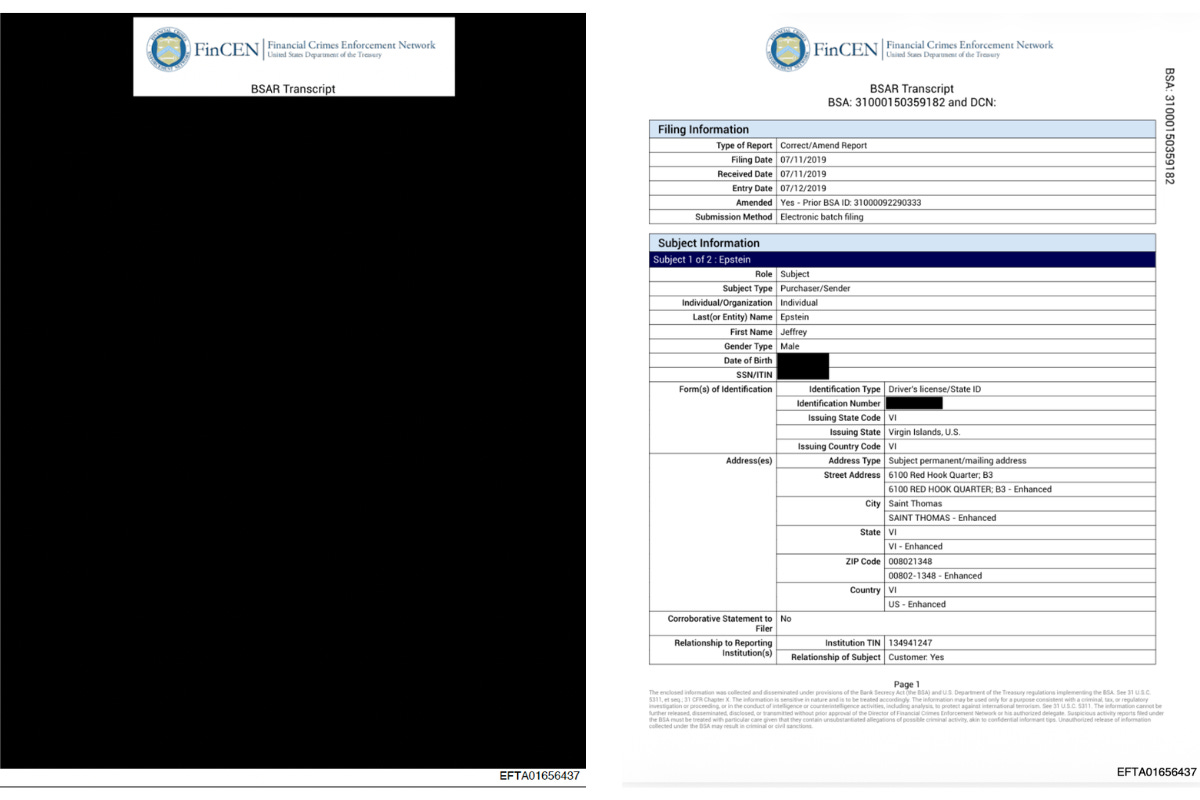
Indyke’s suspicious cash withdrawals, as reported to federal investigators, involved three bank employees: bank teller Nicole Perskawiec, branch manager Firdaus Madiar, and regional compliance and anti-financial crime officer Ying-A Wang. Perskawiec and Madiar were at the bank when Indyke made his withdrawals, and provided eyewitness testimony of Indyke’s alleged attempts to illegally structure his transactions.
While the initial incident flagged by Perskawiec took place in July 2016, Wang’s investigation revealed that Indyke had attempted to circumvent reporting requirements at that same branch as far back as 2014 and continued long after being confronted by compliance officers.
“In connection with the activities detailed in the previous SARs filed,” one of six now-redacted reports on the incident reads, “Indyke made inquiry with branch personnel on more than one occasion regarding the regulatory reporting requirements associated with his intended check withdrawal activities. When advised that a CTR would be required, Indyke altered his transaction pattern, presumably to avoid CTR filing requirements. The current activity appears to be a continuation of Indyke structuring of his cash withdrawal activities in order to avoid the CTR requirement.”
The filings describe a clear pattern over the course of several years: Indyke would cash a $7,500 check from Epstein’s account, followed by another $4,000 from his own, repeatedly asking tellers if his withdrawals would require reporting. If told yes, Indyke would claim that he planned to come back the next day to “avoid all the paperwork and going over his cash limit.”
Internal discussions between bank employees provide a glimpse at both how common — and how unusual — Indyke’s cash grabs were. At the local branch, staff knew Indyke’s requests for large, specific amounts of cash to be a standard occurrence. Their regional colleagues, however, were flabbergasted that his demands were met so casually and without being properly reported.
“There was no email from the client or regional manager saying they’d like 11.5k out of the two accounts on that specific date in advance?” Wang asked in August 2017, when the incident escalated to Deutsche Bank’s compliance department.
“No, sir,” Madiar replied. “Darren or the RM never sends an email. He just walks into the branch.”
“Don’t you guys need to prepare funds in advance for large withdrawals?” said Wang.
“No, we always have enough cash ready to service all our client [sic],” Madiar explained. “Whether, we have an advance email or if they are just walking in. Some banker’s will send out a courtesy email in advance, but for our regular client the just walk in” [sic].
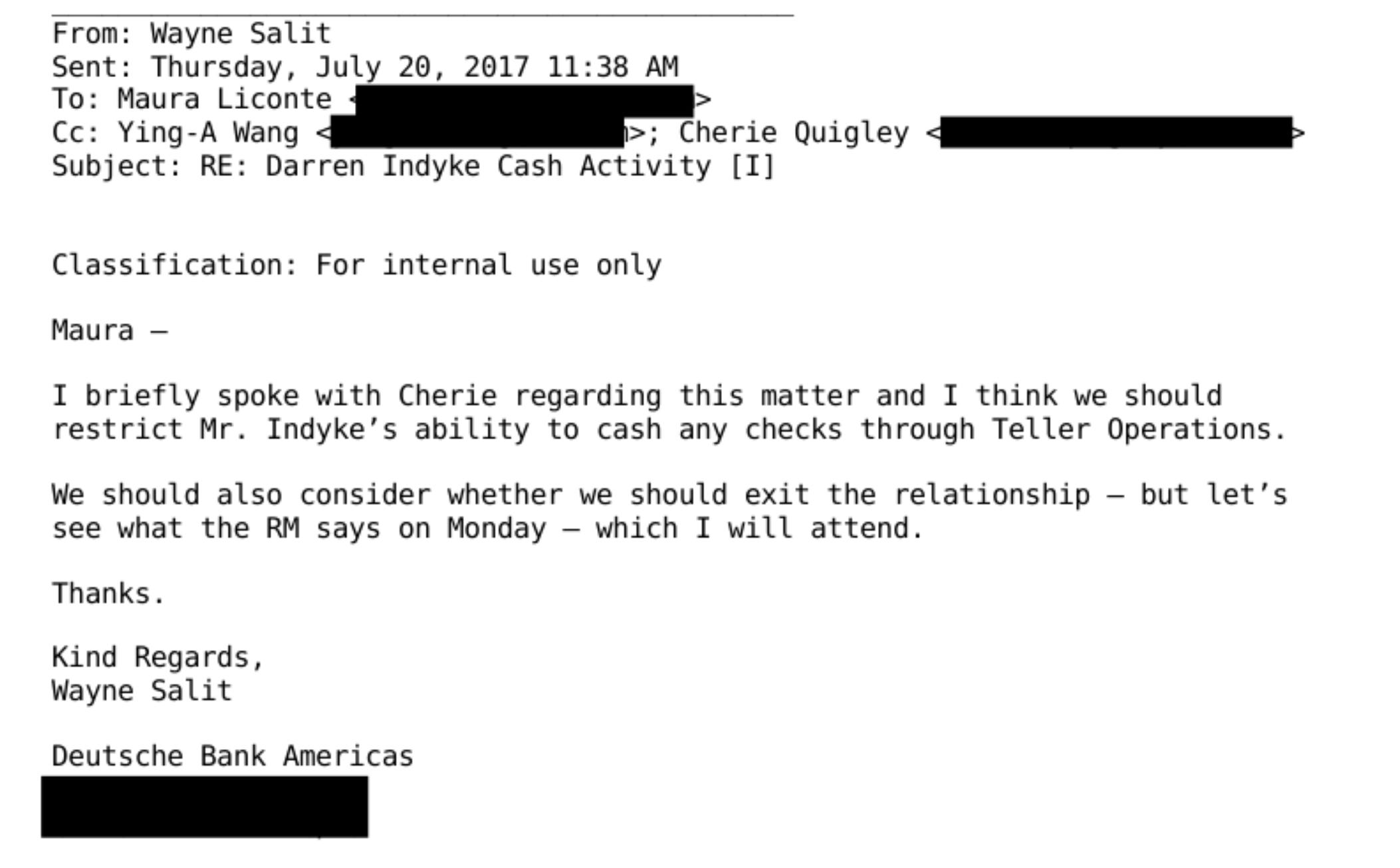
Eventually, the case escalated to Deutsche Bank’s anti-money laundering division, where wealth management agent Cheri Quigley was more direct in her assessment: “This client tends to cash checks frequently and we need the activity to stop.”
While internal bank emails regarding Indyke’s suspicious transactions have been previously reported on, the official SAR documents filed with the US Treasury substantiate allegations previously only alluded to in a 2024 class-action lawsuit Epstein’s victims filed against Indyke and Kahn. They also illustrate a failure by the Trump administration to investigate Epstein’s finances, despite reports of money laundering occurring while he was under investigation for human trafficking.
Further review of confidential SAR reports reveals attempts by Epstein, Indyke, Beller, and Kahn to withdraw large amounts of cash undetected dating back to at least 2003. In one instance, Epstein wired $1.95 million to his JPMorgan Chase account, then attempted to withdraw some of it undetected by writing himself at least 30 checks for $9,800.
This behavior is a textbook example of structured transactions – an illegal method of money laundering designed to bypass CTR reporting requirements. In fact, the Epstein Files contain a Financial Crimes Enforcement Network manual detailing practices strikingly similar to those of Epstein and Indyke. And yet, Congresswoman Lee pointed out, institutions in both the public and private sector allowed such behavior to continue for decades.
“To get to this point, where we have this many survivors, where we have this many high-powered, connected people, this many governments, this many institutions — to have that much failure means that accountability is not going to be a one-off thing,” said Lee.
“Accountability for this is the whole point of the whole release of the Epstein Files. Accountability didn’t stop with Epstein, or Maxwell,” she added. “Accountability has to be: Who are all the people who knew something and didn’t say anything? Who are all the people who turned away when these young girls, these kids, were being ushered in and out of this old man’s house? Where were all the institutions that had failsafes that failed, like the banks?”
Similar instances of suspicious banking activity involving eyewitness accounts from bank tellers have resulted in perjury charges and criminal convictions when properly investigated.
While Ansari believes holding Indyke accountable for potentially committing perjury during his March deposition would be difficult with Republicans controlling Congress and the executive branch, it would signal to anyone else under investigation that those connected to Epstein will no longer be immune from consequences.
“He’s upheld the cover-up for decades, even after Jeffrey Epstein was jailed. But there is also the reality that the DOJ has never interviewed him. So I don’t know if that type of pressure from the federal government were to be exercised, if he would recognize the gravity of the situation,” Ansari said. “When we have a Democratic president, and a new Department of Justice that has committed to finally prosecute people who are involved or enabling these crimes, then maybe Indyke and many others would take this more seriously.”
Advertise in this newsletter
Do you or your company want to support COURIER’s mission and showcase your products or services to an aligned audience of 190,000+ subscribers at the same time? Contact advertising@couriernewsroom.com for more information.
Support our journalism at COURIER
Democracy dies behind a paywall, which is why our journalism is — and always will be — free.
But to keep our commitment to the free access to information, we need support from those who have the means, believe in our mission, and support our unique model.
And the statute of limitations is?
Thanks for airing this out. Great journalism!
The bigger scandal is not that Indyke lied about trying to hide money transfers for Epstein’s sex trafficking, but that Trump’s DOJ wrongfully tried to cover up Indyke’s criminality by improperly redacting documents revealing Indyke’s efforts to hide those transfers.
It seems to me that redacting those documents was a crime in violation of the Epstein Files Transparency Art, and whoever ordered those documents redacted should be indicted.