



Cam here 👋 bringing you your daily dose of what people are doing – good, bad, and otherwise – in the world of politics. We’re diving into the stories you won’t see anywhere else. And remember, you can also keep up with me over on TikTok and Bluesky.

Since day one of Trump’s political career, people have desperately attempted to normalize his absurd abuses of power and blatant corruption – and 10 years later, much of corporate media remains a victim of their own attempts to return to a sense of normalcy.
It’s time to stop sane-washing the insanity.
What Happened
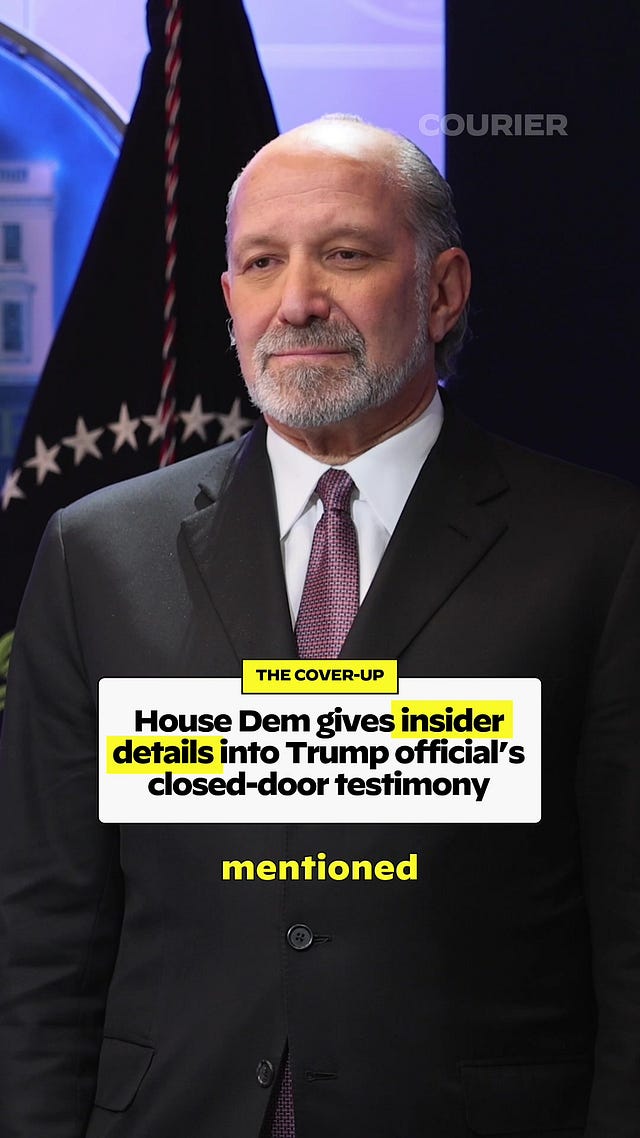
A flustered Commerce Secretary claimed during a closed-door congressional hearing Wednesday that Trump administration officials pressured him to walk back previous claims that convicted sex offender Jeffrey Epstein was “the greatest blackmailer ever” who possessed video footage of his clients abusing girls and women.
Wall Street billionaire and US Commerce Secretary Howard Lutnick spoke with the House Oversight Committee for several hours as part of the committee’s investigation into the government’s lackluster handling of the Epstein case. A key point of contention during the transcribed interview centered on comments Lutnick made in an October 2025 interview with the New York Post, in which he talked about Epstein at length.
“That’s what his MO was, you know: ‘get a massage, get a massage.’ And what happened in that massage room, I assume, was on video,” Lutnick said of Epstein. “This guy was the greatest blackmailer ever. He blackmailed people. That’s how he had money.”
When pressed by US Reps. Ro Khanna (D-CA) and James Walkinshaw (D-VA), Lutnick reportedly became unsettled and repeatedly changed his responses. While the transcript of the interview has not yet been released publicly, Khanna recounted the exchange during a press briefing.
“I think he’s covering up for the administration,” Khanna began. “Secretary Lutnick said on the podcast that there was blackmail going on. Then he says to my inquiry, ‘well, no, no, no, I was just speculating.’”
“What was your basis for speculating?” Khanna asked.
“I didn’t have any basis,” Lutnick replied. “I take it back.”
“Why did you take it back?”
“I talked to administration officials.”
“Who did you talk to?” Walkinshaw interjected.
“No, no, no, I just learned about this in public,” Lutnick responded. I didn’t talk to the administration officials.”
Democratic lawmakers say the exchange points to a broader effort by the Trump administration to minimize the scale of Epstein’s billion-dollar criminal enterprise since Trump retook the presidency. The White House attempting to silence a cabinet member in order to impede a congressional investigation would mark a significant escalation, though not a wholly unprecedented one.
In 2017, Trump instructed his former attorney, Michael Cohen, to lie to Congress about a real estate deal in Russia. Cohen went on to serve three years in prison after being found guilty of making false statements to Congress, tax evasion, and campaign finance violations.
“This is why this is such a cover-up. I mean, he refused to say there was any blackmailing, even though he thought that happened in the past,” said Khanna. “Someone obviously got to him from the administration. In fact, he said he talked to people in the administration and that’s why he’s changed his tune. And the question is not just why he’s lying. The question is why he’s covering up, why he’s no longer willing to share what he knows about Epstein’s abhorrent behavior.”
 Tiktok failed to load.
Enable 3rd party cookies or use another browser
Committee Chair James Comer (R-KY) later held an impromptu press briefing to refute accusations of a cover-up, instead listing off a number of unrelated issues using a deflective rhetorical technique known as whataboutism.
“I feel compelled to have to come out and clean up and correct some of the statements that the Democrats made. I couldn’t believe as I was getting updates of what they were saying, and I hope that when you get the transcripts, you fact check them on what they say,” said Comer. “The only cover-up that I’ve seen on the Oversight Committee is the cover-up of the Democrats trying to cover up our investigations of the Metro Police Department, lying about crime statistics, and the cover-up of the Minnesota fraud.”
Committee members also questioned Lutnick about his past relationship with Epstein, including business dealings, their time as next-door-neighbors in Manhattan, and Lutnick’s 2012 visit to the private island Epstein used to traffic and abuse girls and women. Lutnick had previously denied associating with Epstein after 2005, but changed his story once a portion of the Epstein Files were released in late 2025.
Wednesday’s inquiry marks the beginning of a series of high-profile hearings scheduled by the Oversight Committee as part of its investigation into Epstein. A hearing featuring several of Epstein’s victims and expert witnesses is scheduled for May 12 in Palm Beach, while former US Attorney General Pam Bondi is expected to speak with congressional investigators on May 29. Like Lutnick, Bondi will not be testifying under oath, but committee staff have emphasized that it is still a crime to lie to Congress, regardless of whether or not the subject has been sworn in.
“If we find that there were any misstatements by Lutnick, it’s a felony to lie to Congress, and you’ll be held accountable,” said Comer.
Attempts to Sanewash
Lutnick’s testimony about Epstein draws praise from GOP chair and derision from Democrats
Dueling descriptions from lawmakers on whether Lutnick was forthcoming or evasive about Epstein ties
Commerce Secretary Lutnick appears before a House panel to answer for his changing story on Epstein
Far-Right Spin
The Neighbor Next Door: Howard Lutnick Details Limited Contact With Jeffrey Epstein
US commerce secretary says he was surprised by invitation to Epstein’s Island
Commerce Secretary Howard Lutnick found Epstein island lunch invite ‘unsettling’ – but went anyway

Is Project BLUEMAP on the horizon?
Now that unfettered gerrymandering is effectively the law of the land, control over who draws the maps has become more important than ever.
In most states, the legislature is in charge of drawing congressional and state legislative district boundaries. And thanks in large part to a Republican initiative launched in 2010 called Project REDMAP, a majority of state legislatures have been under Republican control for the past 16 years. That dominance has allowed them to draw increasingly favorable maps that make it harder and harder for Democrats to win seats, even in states where there are more Democratic voters than Republicans.
But according to Democratic Legislative Campaign Committee President Heather Williams, the same factors that helped Project REDMAP succeed in 2010 could be its undoing in 2026.
“Republicans had this advantage at a time when Barack Obama was president and his numbers had been falling, that healthcare and affordability and the economy were core issues. And interestingly, there was sort of a groundswell right of activism around Tea Party activities,” said Williams. “2026 shows us elements the same, although in reverse: We’ve got a president that is deeply underwater, a party that is in power federally that is deeply unliked… And just last week, it was noted that for the first time since before 2010, Democrats are now favored on the economy over Republicans.”
Williams and the DLCC have spent years trying to flip state legislatures, but it’s been a pretty uphill battle — until last year, when those factors she outlined became a driving force for voters, leading to Democrats winning upset victories in special election after special election.
Even in races where Republicans win, margins have narrowed significantly compared to previous cycles. It’s a clear sign from voters that they are increasingly dissatisfied and don’t think the party in power is listening to their needs. As a result, Democrats have successfully defended their control of the Michigan state senate, and are chipping away at Republican supermajorities in states like Arkansas and Florida.
“Democrats have an opportunity to either break the Republican supermajorities or prevent Democrats from falling into them,” explained Williams. “This matters because it puts Democrats into a negotiating room. And that is really important when we think about the path forward on public policy and that ability to really be a part of the conversation.”
The shift comes at a pivotal time for Democrats, as the US Supreme Court last week granted states the ability to redraw congressional maps without regard for racial representation. Republican-controlled legislatures in Louisiana, Alabama, Tennessee, and Mississippi have already begun the process of eliminating predominantly Black districts in order to create room for more white representation in Congress. In Florida, Gov. Ron DeSantis already signed into law new maps that create four new white-majority districts by breaking apart voting blocs made up largely of non-white residents.
In each of those states except Mississippi — where the state senate is led by a Republican majority — both chambers of the legislature are controlled by Republican supermajorities. That dynamic almost always means Democrats are left out of negotiations over proposed legislation, and bills that do pass tend to trend farther to the extreme right.
Democrats broke the Republican supermajority in the Mississippi state senate in 2025 and maintained control of the Michigan state senate after a special election held last Tuesday.

It’s easy for individual members of Congress to get overlooked by national outlets as they quietly skate to reelection again, and again, and again. The following is an overview of different congressional representatives you may not have heard of, with fun facts about their origin stories they’ve tried to keep out of the public narrative.
US Rep. Mike Rogers, Alabama’s 3rd Congressional District
Since taking office in 2003, Rep. Rogers has:
Sponsored 109 bills, two of which have been signed into law
Knowingly accepted over $30,000 in campaign contributions from a PAC tied to a money laundering scheme
Threatened to beat up a voter who asked about ethically questionable contributions to his wife’s county judge campaign
Tried to start a fight with former Rep. Matt Gaetz on the House floor over a committee assignment
Almost been appointed to be Trump’s Defense Secretary, but had to stay in the House so Republicans wouldn’t lose their majority
Blamed ISIS for the 2016 mass shooting at a gay nightclub in Orlando and voted against designating attacks against LGBTQ+ people as a hate crime
Fun Facts
Rep. Rogers was an ardent supporter of former President George W. Bush’s invasion of Iraq — so much so that he hired one of the conflict’s most prolific (alleged) war criminals. Chris Brinson joined Rogers’ congressional staff in 2003 and later served as his chief of staff for about a decade. He came fresh from military service as a US Army Reserve Captain during the Iraq War, where he participated in the ongoing human rights violations at Abu Ghraib prison.
The scandal gained international attention after 60 Minutes published a report with photos showing American soldiers dragging naked prisoners on leashes and shocking them with electric wires. Prisoners were also forced to masturbate in front of female soldiers.
Brinson was formally reprimanded by the US Army for his involvement in the abuses — physical and psychological torture, rape, and murder — that occurred under his watch. From there, he went straight to Rogers’ office, where he was welcomed with open arms.
“Chris’ influence on my office is immeasurable; my staff in Alabama and DC revere him, and without his help, I would not have successfully run for two chairmanships,” Rogers said of Brinson. “I have some of the longest-serving staff on Capitol Hill and that’s in part to what Chris has done for our team.”
Rogers’ personal net worth has fluctuated considerably during his time in Congress. Financial disclosures placed him right around the $1 million mark when he first took office, but mounting liabilities over the years left him among the poorest members of Congress by 2018, with an estimated $600,000 in debt. He seems to have bounced back, somewhat; his latest disclosure from 2023 shows he’s around $250,000 in the black.

COURIER’s newly-launched Epstein investigation project
For too long, the Epstein Class has dealt in wealth, power, and politics to avoid accountability and deny victims & survivors their due justice. The public deserves the truth, but the Trump Administration is failing its legal obligation to deliver it.
That’s why we’re expanding our coverage to follow the money and investigate the power players in and outside the government. With a new database by Thorian AI, we have unprecedented access and ability to navigate more than 1.2M files and we’re sharing access—and what we’re finding—with you.
Subscribe to The Cover-Up and get one concise, easy-to-read email a week that cuts through the noise with the headlines you need and the breakdowns you want.
By staying plugged in and leveraging our reporting to make your own calls-to-action louder, together, we can turn information into justice.
Advertise in this newsletter
Do you or your company want to support COURIER’s mission and showcase your products or services to an aligned audience of 190,000+ subscribers at the same time? Contact advertising@couriernewsroom.com for more information.
Support our journalism at COURIER
Democracy dies behind a paywall, which is why our journalism is — and always will be — free.
But to keep our commitment to the free access to information, we need support from those who have the means, believe in our mission, and support our unique model.
Thank you, Mr. Stevenson. lutnick sounds perfectly sane.
So the confession confessed, then unconfessed, then stood there in a cheap suit asking us not to believe our own ears.
That’s not a walk-back — that’s a guilty little waltz in the ballroom of empire. The truth keeps clawing at the floorboards, and every denial sounds more like a door being locked from the inside.