

ICE is releasing people who are dying in order to avoid reporting their death
ALSO INSIDE: After year of depositions on Epstein, Comer promises criminal referrals by Christmas


Cam here 👋 bringing you your daily dose of what people are doing – good, bad, and otherwise – in the world of politics. We’re diving into the stories you won’t see anywhere else. And remember, you can also keep up with me over on TikTok and Bluesky.

Deaths at Delaney Hall
Immigration officials have used a new reporting loophole to conceal the deaths of at least two individuals who were abruptly released from custody amidst medical emergencies.
Jose Chajon-Raxon was booked into the privately-run Delaney Hall in New Jersey on July 18 and began experiencing recurring seizures shortly after his arrest. It wasn’t until four days later that he was released and sent to the hospital, where he died shortly after his arrival. Less than two weeks later, Edwin Lopez-Cornejo experienced a similar fate. After being denied prescription medication for over a month, he experienced a medical emergency, was quickly released from custody, and died.
Neither family was alerted that their relative had been transferred until after their death. In both cases, ICE did not file a report and refused for days to confirm what had happened, only relenting after sustained pressure from activists, lawmakers, and the families of Chajon-Raxon and Lopez-Cornejo. Rep. LaMonica McIver (D-NJ), a vocal critic of the facility who successfully conducted an oversight visit in December, said the private prison company that runs Delaney Hall does not provide adequate onsite medical care for those in detention.
“GEO Group does in-house for most of their medical services. We’ve gone many times and we’re like, ‘Hey, where’s the physician? Not here,’” McIver told COURIER. “They’ll have an RN there, or maybe some assistants on staff, but never 24/7 a physician — which is problematic in the first place. We’re like, ‘Give us answers on how a person intakes. How do you make sure people are getting their medicine? What is the routine?’ And it’s never consistent, never transparent.”
The process has become even less transparent since June, when ICE ended a policy requiring the department to report to Congress the death of any individual who died within 30 days of being detained. With the policy gone, detention staff are no longer required to report a death as long as the individual is released before they die, as was the case with Lopez-Cornejo, Chajon-Raxon, and an unknown number of others who may have been released while experiencing medical emergencies.

 Tiktok failed to load.
Enable 3rd party cookies or use another browser
The change is part of an ongoing effort by the Trump administration to restrict what the public knows about conditions in immigration detention. McIver had attempted to conduct an oversight visit for months before she finally gained access. DHS has since changed the rules around when a member of Congress can conduct an inspection, how long they can stay, who they can talk to, and how much notice they’re required to give before being granted access.
The Trump administration has also attempted to make an example of McIver in an effort to dissuade her colleagues from conducting similar visits. In May 2025, McIver was arrested outside Delenay Hall and charged with assaulting officers. The case is ongoing, and McIver says the legal threats against her have only strengthened her resolve.
“It’s all a part of their agenda — the Trump administration’s agenda. Cruelty is the point of everything that they do,” said McIver. “They tried to stop me last May. But since then — with me even returning, and going back multiple times — there’s always a new rule. There’s always something. ‘Oh, you can’t talk to these people, you can’t do this, you can’t do that.’ Because they’re literally trying to cover up the cruelty.”
In 2025, 33 people that we know of died in ICE custody — more than during the entire Biden administration. This year, there have been 26, but thanks to the new reporting rules, the only reason the public knows about the two most recent deaths at Delaney Hall is that members of Congress like McIver, activists, and family members of those taken by ICE are there every day, pushing for answers.

One year in: Oversight Chair eyes criminal referrals in Epstein probe
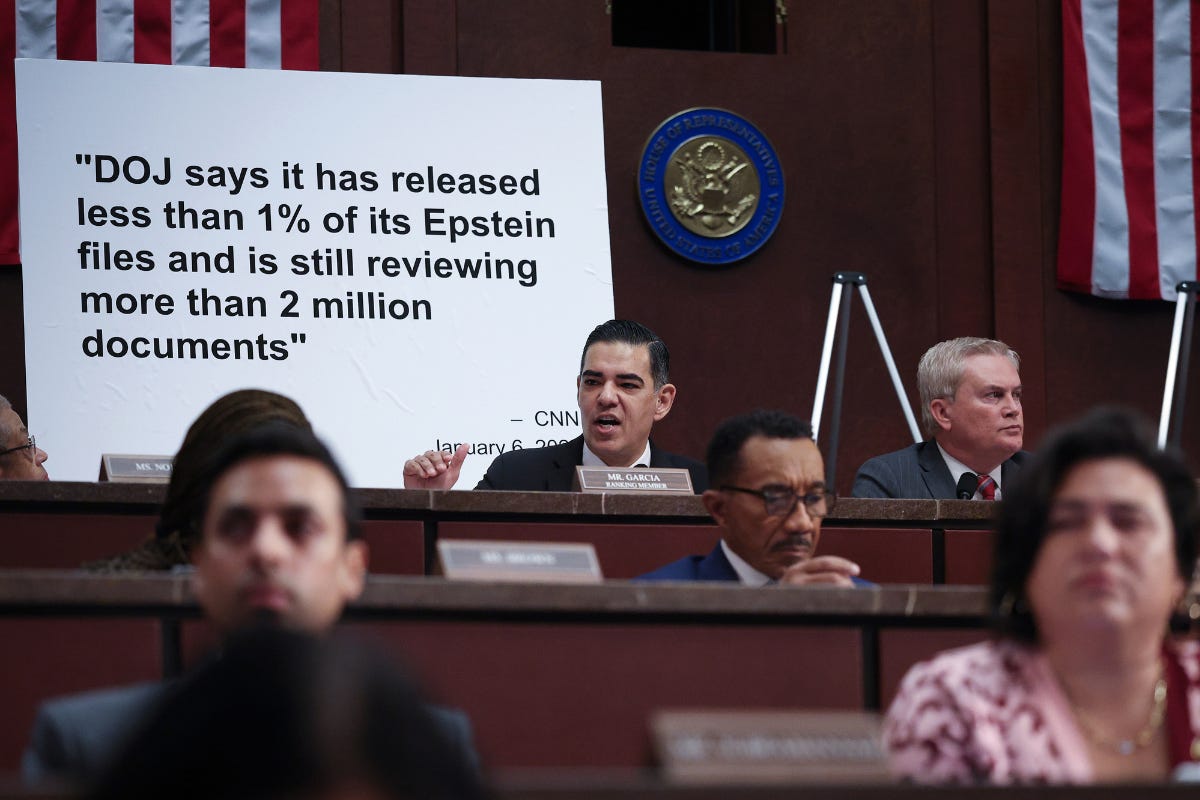
A congressional investigation into Jeffrey Epstein’s criminal network is expected to submit criminal referrals to prosecutors by the end of the year, as Republicans face mounting pressure from voters to act before the midterm elections.
Leaders from both parties on the House Oversight Committee have now committed to pursuing criminal charges based on discoveries made in its ongoing investigation into Epstein. Ranking member Rep Summer Lee (D-PA) told COURIER in April that perjury charges should be brought against former Attorney General Pam Bondi and Darren Indyke, Epstein’s former attorney, for lying to the committee. Rep. James Comer (R-KY) told NOTUS he expects to send referrals to the Justice Department before his term as chair ends in December.
Below The Belt(way) is a reader-supported publication. To receive new posts and support my work, consider becoming a free or paid subscriber.
“I fully expect criminal referrals, and some things — we’ve found enough that I believe the Department of Justice should look into certain people, “Comer said. “We’re going to do everything we can to hold anyone accountable who’s still alive.”
Since conducting its first deposition with former Attorney General William Barr in August 2025, the committee has questioned a number of current and former government officials, as well as Epstein’s friends, staff, clients, and prison guard. It has privately spoken with witnesses and survivors, conducted depositions and hearings in New York, Ohio, and Florida, and released thousands of previously unseen documents obtained from Epstein’s estate.
Many of those brought in by the committee were never contacted by the DOJ as part of its investigation into Epstein, despite the department compiling more than 6 million records on the convicted sex criminal’s multibillion-dollar international human trafficking empire.
Democrats on the committee have expressed frustration over the way Comer has handled the investigation, opting for voluntary interviews rather than mandatory depositions under oath and on camera. While the approach has yielded results, Rep. Yassamin Ansari (D-AZ) believes it has also produced disingenuous testimony and would like to hold future hearings in public, backed by the legal weight of congressional subpoenas.
“That’s how every single one of these should be: under oath in a public hearing in front of the American people, videotaped,” Ansari said. “We need full transparency for the survivors as well as for the American public.This cover-up has to end immediately.”
Rep. Robert Garcia (D-CA), who would become committee chair next year should Democrats win a majority in the House, already has committee staff “working on preparation, letters, research.” He plans to issue a slew of subpoenas and hold public hearings to expose what he has described as one of the most extensive government cover-ups in the history of the United States. At the top of Garcia’s subpoena list are First Lady Melania Trump, who has been accused of being entangled in Epstein’s trafficking network, and President Donald Trump, a longtime friend of Epstein who is believed to be impeding the committee’s investigation behind the scenes.
And voters may soon give him the chance to do so. Comer has been one of the few — and often only — Republicans on the committee to participate in the investigation, and the campaign strategies of Democrats in swing states suggest the electorate still hasn’t forgiven Republicans for their resistance to releasing the Epstein Files. That, coupled with the Trump administration’s decision to close its criminal investigation into Epstein despite having only one conviction under its belt, have made accountability for Epstein’s enablers a focal point of Democratic attack ads in Arizona, Georgia, Ohio, Tennessee, and Wisconsin.
For Comer, who is expected to easily win reelection, taking action on Epstein could have consequences that extend well beyond the midterms. The five-term Republican is expected to run for Congress next year, where he could square off against Rep. Thomas Massie, known for spearheading the passage of the Epstein Files Transparency Act. Criminal prosecutions stemming from the investigation before Comer’s term-limited tenure as committee chair ends could help put him on equal footing with Massie, whereas failing to do so could put him at a severe disadvantage.
While criminal referrals now seem likely no matter which party is in control, what would happen with those recommendations remains unknown. US Attorney General Todd Blanche has repeatedly shown a softer side for Epstein’s co-conspirators than he has for his victims. Last August, he moved Epstein accomplice and convicted sex trafficker Ghislaine Maxwell to a low-security prison, and last month refused to follow leads given to him during a meeting with survivors.
It could take significant pressure from Congress to force Blanche’s hand — pressure both Comer and Garcia have promised to apply if necessary.
Support our journalism at COURIER
Democracy dies behind a paywall, which is why our journalism is — and always will be — free.
But to keep our commitment to the free access to information, we need support from those who have the means, believe in our mission, and support our unique model.