


Cam here 👋 bringing you your daily dose of what people are doing – good, bad, and otherwise – in the world of politics. We’re diving into the stories you won’t see anywhere else. And remember, you can also keep up with me over on TikTok and Bluesky.
[ PLEDGE ]

Since day one of Trump’s political career, people have desperately attempted to normalize his absurd abuses of power and blatant corruption – and 10 years later, much of corporate media remains a victim of their own attempts to return to a sense of normalcy.
It’s time to stop sane-washing the insanity.
What Happened
Internal communications from the Department of Justice reveal that the decision to close the investigation into Jeffrey Epstein was made after a narrowly focused review of less than 7% of the case files, centered entirely on photo and video evidence.
FBI Director Kash Patel tasked agents in March 2025 to “determine if there are any images of individuals on any videos which should be considered for prosecution,” according to emails published as part of the Epstein Files Transparency Act. The resulting review examined an estimated 400,000 of the 6 million files compiled against Epstein and did not include financial documents, personal communications, or a majority of witness testimony.
The review was conducted by an agent working out of the DOJ’s Southern District of New York office and completed within a few hours of the request. It supposedly found no evidence implicating anyone other than Epstein and his now-convicted accomplice, Ghislaine Maxwell.
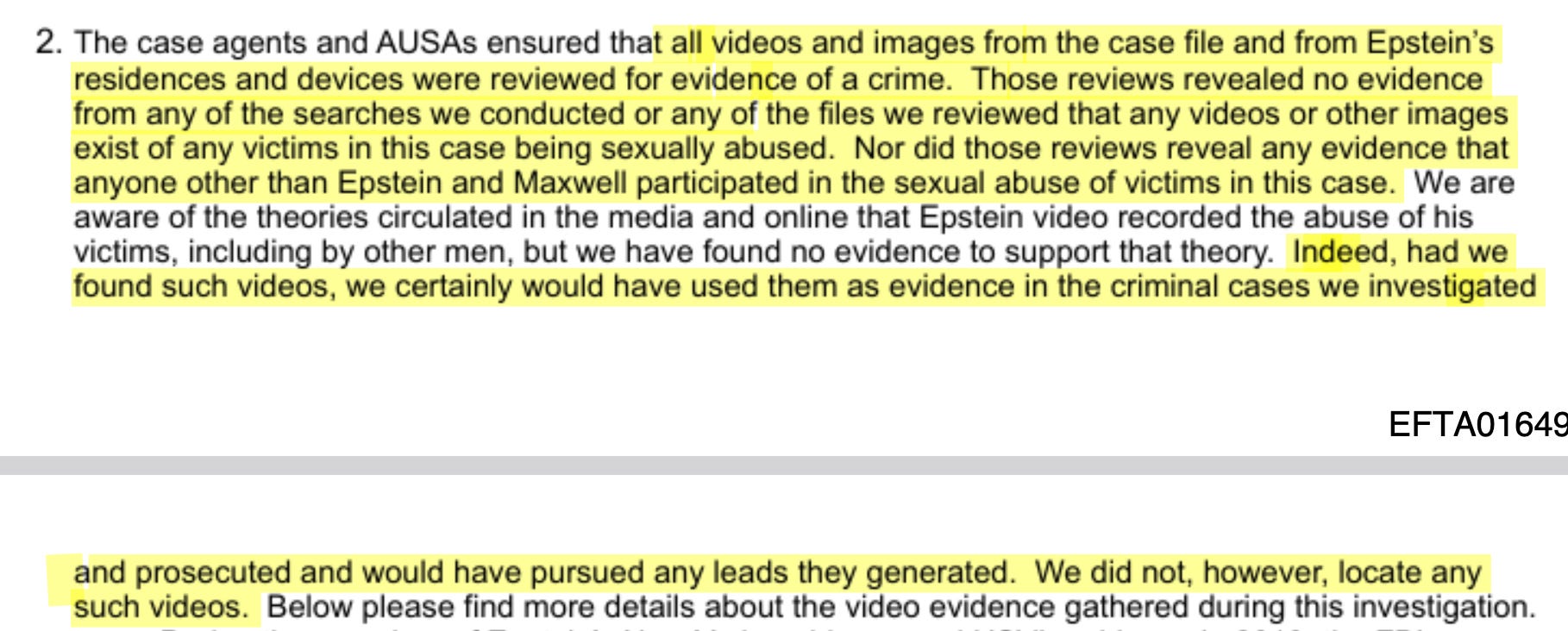
“All videos and images from the case file and from Epstein’s residences and devices were reviewed for evidence of a crime,” the agent wrote in their analysis. “Those reviews revealed no evidence from any of the searches we conducted or any of the files we reviewed that any videos or other images exist of any victims in this case being sexually abused. Nor did those reviews reveal any evidence that anyone other than Epstein and Maxwell participated in the sexual abuse of victims in this case.”
The internal memo sheds new light on the agency’s abrupt decision to end its investigation into Epstein’s multi-billion dollar sex trafficking operation, and adds context to the public memo on the matter that many derided as woefully insufficient. In the analysis, the agent emphasized that their determinations were made exclusively based on visual evidence, and even that was limited to include investigations specific to the SDNY.
The review omitted all surveillance footage, for example, as the 2019 search warrant executed at Epstein’s properties only authorized confiscation of evidence related to crimes committed within the preceding 20 years. Witness testimony was also severely limited: anything other than on-camera interviews with the Palm Beach Police department was not considered.
The language in Patel’s official FBI memo announcing the closure of the investigation mirrors the internal analysis almost identically, and a reexamination of the text suggests the video and image elements were the only determining factors.
“The files relating to Epstein include a large volume of images of Epstein, images and videos of victims who are either minors or appear to be minors, and over ten thousand downloaded videos and images of illegal child sex abuse material and other pornography. Teams of agents, analysts, attorneys, and privacy and civil liberties experts combed through the digital and documentary evidence” the memo stated. “This systematic review revealed no incriminating ‘client list.’ There was also no credible evidence found that Epstein blackmailed prominent individuals as part of his actions. We did not uncover evidence that could predicate an investigation against uncharged third parties.”
The DOJ and FBI did not respond to requests for comment on this story.
The decision to close the investigation into Epstein’s criminal enterprise without pursuing additional inquiries into potential accomplices or co-conspirators was seen as a miscarriage of justice by survivors, witnesses, and members of Congress, particularly after the DOJ acknowledged that there were “over one thousand victims” connected to the case.
Two weeks after the investigation was closed, Democrats on the House Oversight Committee forced a vote to open an inquiry into the government’s handling of the files. Patel’s decision not to pursue charges based on a small, selective portion of evidence reinforces committee members’ assertion that the DOJ has been involved in a cover-up to protect those implicated from harm.
“This is obviously really concerning. We have a lot of questions about this,” said Rep. Robert Garcia (D-CA), ranking member of the Oversight Committee. “We have some other information as it relates to the FBI director and the way he’s mismanaged the redaction process, so there are a lot of questions for Kash Patel, including the really serious ones that you raised. And so this is why Kash Patel has got to be in front of the committee, and he’s got to answer our questions.”
On Tuesday, Garcia sent a letter to committee chair Rep. James Comer (R-KY) requesting that Patel and acting Attorney General Todd Blanche be brought in for questioning.
 Tiktok failed to load.
Enable 3rd party cookies or use another browser
Patel and Blanche were repeatedly referenced by former Attorney General Pam Bondi during her recent interview with the committee, during which she redirected nearly all criticism to her subordinates. According to Bondi, Blanche handled the day-to-day affairs of the Epstein investigation — including transferring convicted sex trafficker Ghislaine Maxwell to a more desirable prison with low security and luxurious amenities — while Patel oversaw the consolidation of the files and redaction process.
“Pam Bondi deflected to Todd Blanche over 30 times. I mean, it was crazy how often she would put the blame on Blanche. So, if that’s going to be the case, we want to talk to Blanche. We want to understand why Bondi was saying that Blanche was the one in charge of the redactions, in charge of the investigation. He has questions to answer,” said Garcia. “She did mention Patel numerous times on the FBI redaction side. And so we have questions obviously for Kash Patel. These are people that we want to talk to as soon as possible.”
Survivors of Epstein’s abuse have also come forward in support of Garcia’s request, demanding answers as to why they were never contacted by the DOJ as part of its investigation and why the FBI failed to redact personal and identifying information about them while adding redactions to the names of those implicated in criminal activity.
Nationwide anti-corruption tour aims to help local communities fight back against political corruption
While polarization is part of the Trump administration’s brand, Donald Trump’s insistence on using his position for personal gain has united voters around one issue: the fight against corruption.
Concerns about political corruption rank among voters’ top issues — even higher than affordability, according to polling commissioned by the political action committee End Citizens United. Anti-corruption sentiment spans the political spectrum, exacerbated by Trump’s penchant for trading stocks based on privileged information, abusing the unregulated cryptocurrency market, and selling pardons for profit and personal favors.
While the six-times-bankrupted Trump and his family have leveraged his position in public service to make $4 billion, wages across the US have remained stagnant, the cost of basic necessities has skyrocketed, and inflation has risen to its highest point in nearly a year with no sign of relief.
“Americans are fed up with the pay-to-play culture that has taken over government,” said Tiffany Muller, president of End Citizens United. “They’re watching the cost of everyday essentials like groceries and health care go up while wages stagnate and opportunities disappear. At the same time, they see their elected officials tripping over themselves to reward billionaire donors and corporations while working families get ignored.”
Many, including Muller, see her organization’s namesake as the root of the problem: since the US Supreme Court’s 2010 ruling in Citizens United v. FEC, the amount of money spent on political campaigns per cycle has exploded. In presidential elections alone, spending — largely by corporations and billionaires — increased from $16 million in 2008 to $2.6 billion in 2024.
In an attempt to tap into that frustration and give voters resources to fight back against corruption in local and national politics, End Citizens United plans to hold a nationwide Kick Out Corruption tour. At each stop, local politicians will present their plans to address the abuses of position and power that have become entrenched in modern American politics.
The tour is a joint effort between End Citizens United and anti-corruption advocacy nonprofit Stand Up America. The first stop is scheduled for June 7 in Tempe, Arizona, where Sen. Mark Kelly will deliver remarks focused primarily on stock trading. He is expected to outline his legislation that would require members of Congress and their families to put their stock holdings in blind trusts while in office, preventing them from profiting from nonpublic information obtained through their positions.
At least seven stops are planned for the tour so far. In addition to insider trading, organizers plan to address aspects of corruption that tend to fly under the radar, including politicians changing the rules in order to remain in power — such as through congressional gerrymandering — and preferential treatment for donors once in office, like the no-bid contracts awarded to private prison contractor GEO Group, a major Trump donor.
“Americans are paying more for health care, housing, and groceries because Donald Trump has handed Washington over to billionaires and powerful corporations who benefit when the system stays broken,” said Christina Harvey, executive director of Stand Up America. “The Kick Out Corruption Tour is our chance to elevate leaders who are serious about the reforms that will be needed to end the era of government by and for the powerful few.”

It’s easy for individual members of Congress to get overlooked by national outlets as they quietly skate to reelection again, and again, and again. The following is an overview of different congressional representatives you may not have heard of, with fun facts about their origin stories they’ve tried to keep out of the public narrative.
US Rep. Abe Hamadeh, Arizona’s 8th Congressional District
Since taking office in 2025, Rep. Hamadeh has:
Sponsored 25 bills, none of which have been signed into law
Praised Trump’s military birthday parade and was rewarded with Trump’s endorsement
Allegedly altered his mom’s ballot to vote for Barack Obama in 2008
Ran on election denialism because “the crazies love to see me fighting”
Spent his teenage years on Ron Paul message boards, where his 4,000+ posts are littered with sexism, antisemitism, and confessions of voter fraud
Fun Facts
Shortly after winning his election, an elderly Democratic constituent went to Hamadeh’s office to talk with him. Instead of meeting with her, his office had her car towed. They then lied about it, but records from the tow yard have Hamadeh’s office as the point of contact for the tow. Not the most neighborly move, but odds are Hamadeh and the people he represents live anywhere near each other, since he doesn’t live in the district.
When first running for office in 2022, Hamadeh was an unknown longshot. It wasn’t until he tricked Trump into endorsing him—thanks to his announcement that he raised a massive $1 million in campaign contributions—that he became a frontrunner. The war chest turned out to be smoke and mirrors: Hamadeh’s brother loaned the campaign $1 million shortly before the campaign finance reporting period ended, and the money was returned shortly after.
And, oddly enough, Trump endorses Hamadeh on his birthday weekend every year.
After losing his bid to be Arizona Attorney General, Hamadeh spent the next several years—including during his congressional run—suing the state to swear him in. He claimed in court that he was “personally entitled” to be the state’s chief legal officer.
In the early 2000s, when he wasn’t on the Ron Paul Forums advocating for ethnic cleansing—he believed it was “good we’re targetting [sic] Arabs now, next we target Jews” — he was writing Sarah Palin fan mail.
COURIER’s newly-launched Epstein investigation project
For too long, the Epstein Class has dealt in wealth, power, and politics to avoid accountability and deny victims & survivors their due justice. The public deserves the truth, but the Trump Administration is failing its legal obligation to deliver it.
That’s why we’re expanding our coverage to follow the money and investigate the power players in and outside the government. With a new database by Thorian AI, we have unprecedented access and ability to navigate more than 1.2M files and we’re sharing access—and what we’re finding—with you.
Advertise in this newsletter
Do you or your company want to support COURIER’s mission and showcase your products or services to an aligned audience of 190,000+ subscribers at the same time? Contact advertising@couriernewsroom.com for more information.