


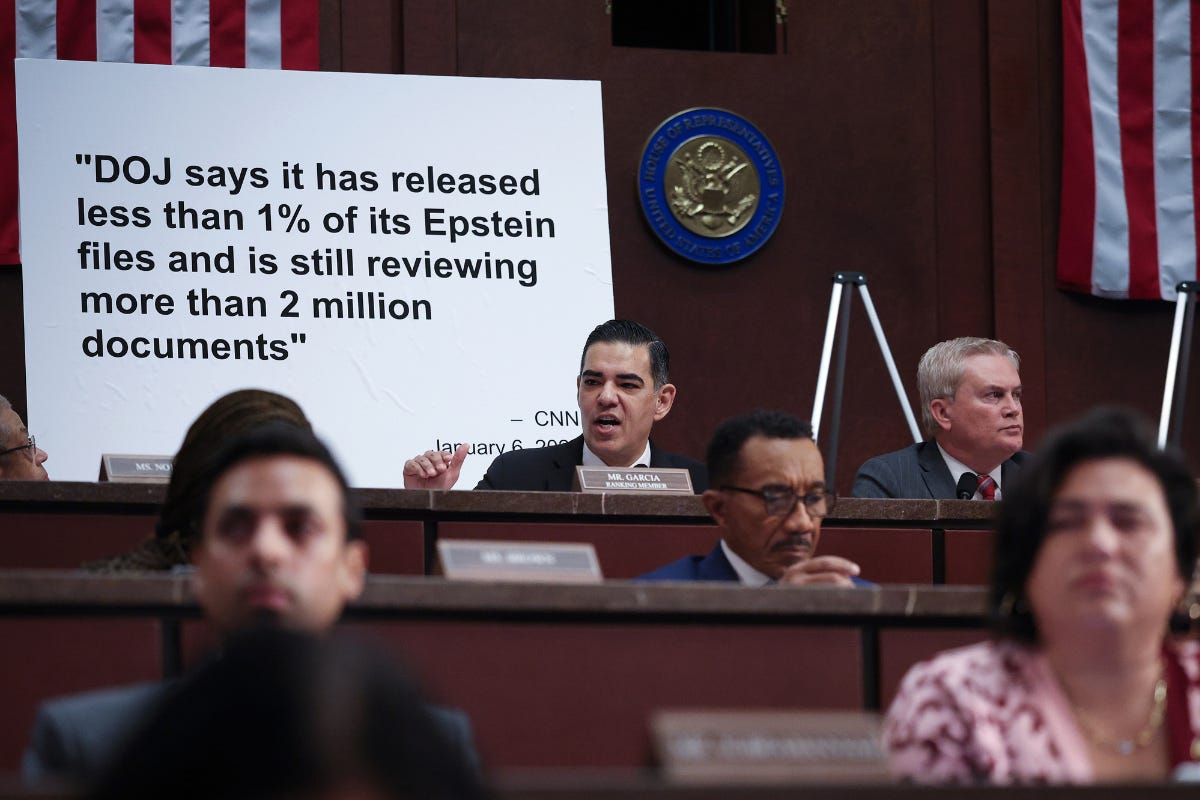
A congressional investigation into Jeffrey Epstein’s criminal network is expected to submit criminal referrals to prosecutors by the end of the year, as Republicans face mounting pressure from voters to act before the midterm elections.
Leaders from both parties on the House Oversight Committee have now committed to pursuing criminal charges based on discoveries made in its ongoing investigation into Epstein. Ranking member Rep Summer Lee (D-PA) told COURIER in April that perjury charges should be brought against former Attorney General Pam Bondi and Darren Indyke, Epstein’s former attorney, for lying to the committee. Rep. James Comer (R-KY) told NOTUS he expects to send referrals to the Justice Department before his term as chair ends in December.
“I fully expect criminal referrals, and some things — we’ve found enough that I believe the Department of Justice should look into certain people, “Comer said. “We’re going to do everything we can to hold anyone accountable who’s still alive.”
Since conducting its first deposition with former Attorney General William Barr in August 2025, the committee has questioned a number of current and former government officials, as well as Epstein’s friends, staff, clients, and prison guard. It has privately spoken with witnesses and survivors, conducted depositions and hearings in New York, Ohio, and Florida, and released thousands of previously unseen documents obtained from Epstein’s estate.
Many of those brought in by the committee were never contacted by the DOJ as part of its investigation into Epstein, despite the department compiling more than 6 million records on the convicted sex criminal’s multibillion-dollar international human trafficking empire.
Democrats on the committee have expressed frustration over the way Comer has handled the investigation, opting for voluntary interviews rather than mandatory depositions under oath and on camera. While the approach has yielded results, Rep. Yassamin Ansari (D-AZ) believes it has also produced disingenuous testimony and would like to hold future hearings in public, backed by the legal weight of congressional subpoenas.
“That’s how every single one of these should be: under oath in a public hearing in front of the American people, videotaped,” Ansari said. “We need full transparency for the survivors as well as for the American public.This cover-up has to end immediately.”
Rep. Robert Garcia (D-CA), who would become committee chair next year should Democrats win a majority in the House, already has committee staff “working on preparation, letters, research.” He plans to issue a slew of subpoenas and hold public hearings to expose what he has described as one of the most extensive government cover-ups in the history of the United States. At the top of Garcia’s subpoena list are First Lady Melania Trump, who has been accused of being entangled in Epstein’s trafficking network, and President Donald Trump, a longtime friend of Epstein who is believed to be impeding the committee’s investigation behind the scenes.
And voters may soon give him the chance to do so. Comer has been one of the few — and often only — Republicans on the committee to participate in the investigation, and the campaign strategies of Democrats in swing states suggest the electorate still hasn’t forgiven Republicans for their resistance to releasing the Epstein Files. That, coupled with the Trump administration’s decision to close its criminal investigation into Epstein despite having only one conviction under its belt, have made accountability for Epstein’s enablers a focal point of Democratic attack ads in Arizona, Georgia, Ohio, Tennessee, and Wisconsin.
For Comer, who is expected to easily win reelection, taking action on Epstein could have consequences that extend well beyond the midterms. The five-term Republican is expected to run for Congress next year, where he could square off against Rep. Thomas Massie, known for spearheading the passage of the Epstein Files Transparency Act. Criminal prosecutions stemming from the investigation before Comer’s term-limited tenure as committee chair ends could help put him on equal footing with Massie, whereas failing to do so could put him at a severe disadvantage.
While criminal referrals now seem likely no matter which party is in control, what would happen with those recommendations remains unknown. US Attorney General Todd Blanche has repeatedly shown a softer side for Epstein’s co-conspirators than he has for his victims. Last August, he moved Epstein accomplice and convicted sex trafficker Ghislaine Maxwell to a low-security prison, and last month refused to follow leads given to him during a meeting with survivors.
It could take significant pressure from Congress to force Blanche’s hand — pressure both Comer and Garcia have promised to apply if necessary.

COURIER’s newly-launched Epstein investigation project
For too long, the Epstein Class has dealt in wealth, power, and politics to avoid accountability and deny victims & survivors their due justice. The public deserves the truth, but the Trump Administration is failing its legal obligation to deliver it.
That’s why we’re expanding our coverage to follow the money and investigate the power players in and outside the government. With a new database by Thorian AI, we have unprecedented access and ability to navigate more than 1.2M files and we’re sharing access—and what we’re finding—with you.
Subscribe to The Cover-Up and get one concise, easy-to-read email a week that cuts through the noise with the headlines you need and the breakdowns you want.
By staying plugged in and leveraging our reporting to make your own calls-to-action louder, together, we can turn information into justice.